• About

All Sparkled Up

~ Like dew hanging from the tip of a leaf, a single bead or word adds sparkle where there was none. BE the bright!

All Sparkled Up

Category Archives: tutorial

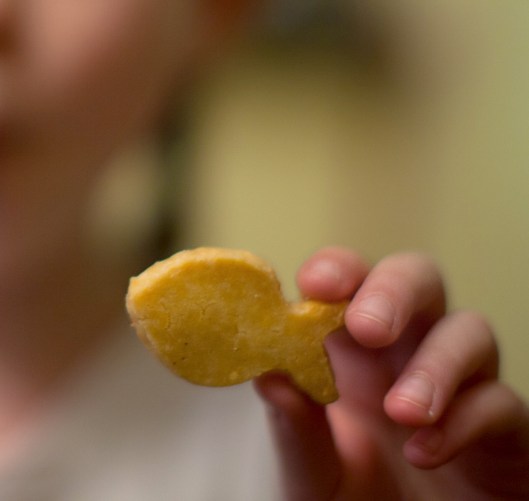
Homemade Goldfish Crackers by the slice

02 Friday Aug 2013

Posted by Julia Monroe in baking, food, grandkids, recipe, tutorial

≈ 5 Comments

Tags

after school snack, baking, cheddar crackers, crackers, food, Goldfish crackers, homemade crackers, king arthur flour, recipe, snack, tutorial

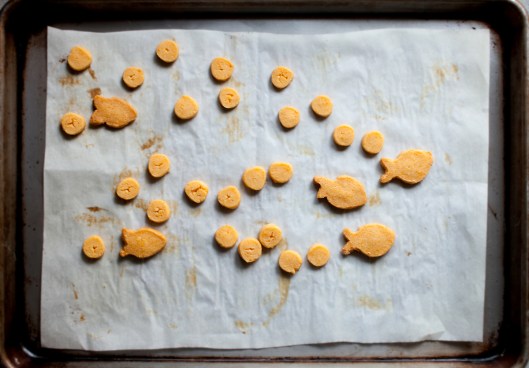
The boys say the flavor is closer to Cheez-Its than Goldfish, but either way they are delicious!
I used King Arthur Flour’s recipe for Cheese Pennies from their Baker’s Companion cookbook.
This is our version to make the Goldfish.
2 cups finely grated sharp cheddar cheese
8 tbsp unsalted butter
1 1/2 cups unbleached all-purpose flour
1/2 tsp salt
1/2 tsp dry mustard
a generous 1/8 tsp Ground Red Chipotle

In a bowl, combine all ingredients to make a dough that sticks together. Add one teaspoon of water at a time if necessary, just enough to make the dough squeeze together. Squish the dough together and it should be a nice consistency, like playdough. Which is great because the next part is playing with the dough!

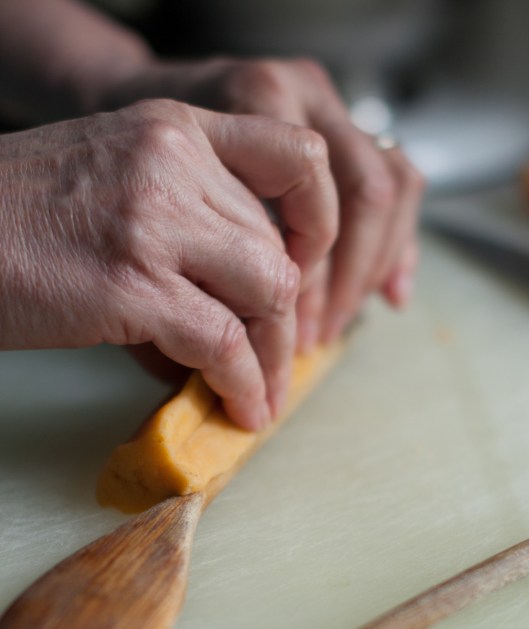
Divide the dough into a couple pieces. We made two small 1/2″ logs for “bubbles” and three 1 1/4″ logs to make the fish. To make the gold fish, work with one log at a time.
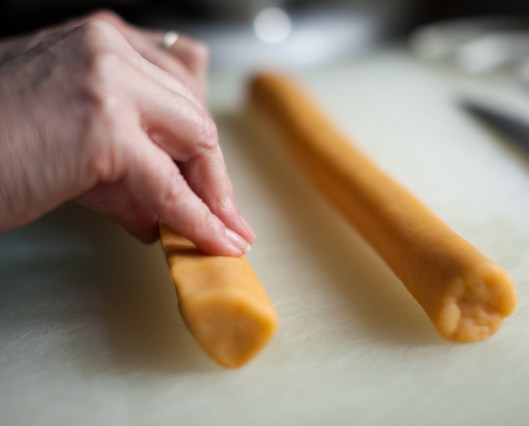
1 Pinch the length of the top for the mouth end of the fish.

Pinch along the roll to form the front of the fish.

Pinch along the roll to form the front of the fish.


2 2 Goldfish
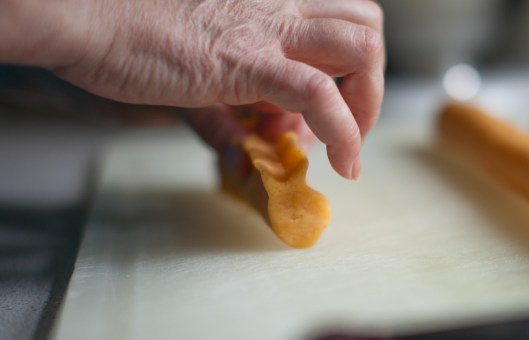
3 For the tail, carefully slit about 1/4″ into the round side of the log. 3 Goldfish
4. Pinch the two sides of the slit you made in the log to form the two tail fins. 4 Goldfish
5 As you pinch the fins out, also press at the base of the fin to form the fish body shape. 5 Goldfish
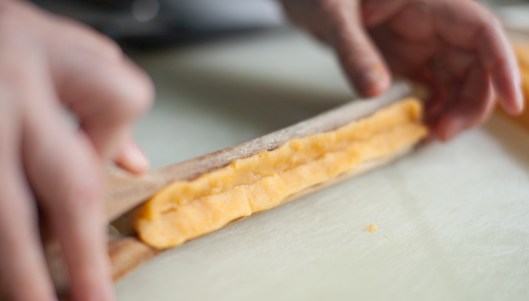
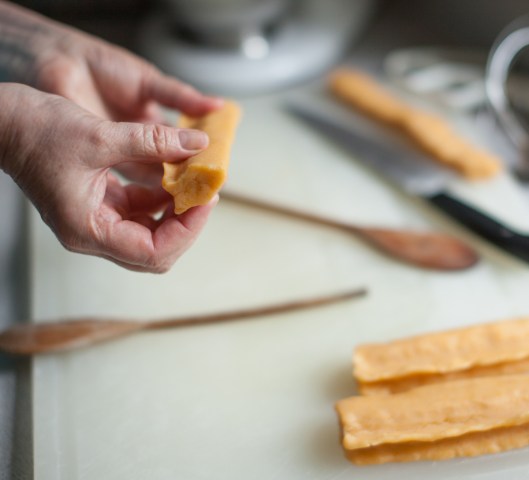
6 Once the basic tail shape has been formed, press the tail between two wood spoon handles to straighten out the fish body. 6 Goldfish
7 7 Goldfish
8 I also pressed each side of the tail against the spoon if the tail seemed too misshapen. 8 Goldfish
9 The finished goldfish roll. 9 Goldfish
10 Repeat for the other two rolls of dough to make goldfish rolls. 10 Goldfish
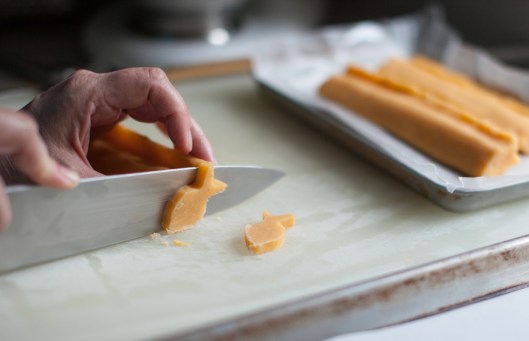
11 Place the rolls on wax paper on a tray and place in freezer for no more than 20 minutes. If the dough is too cold, it might crack as you slice it. If it gets frozen, just let it thaw for a couple minutes before slicing. 11 Goldfish
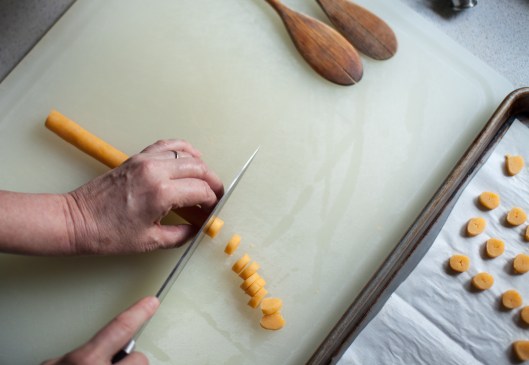
12 To make the bubbles, cut the round roll into 3/16″ slices and place on a parchment-lined baking sheet. The crackers don’t raise so they can be placed fairly close together. 12 Goldfish
13 Bake the round “bubbles” at 375 for about 9 minutes. They won’t burn quickly so just watch them and pull them out when they are lightly brown on the bottoms. Turn out on paper towels to cool. 13 Goldfish
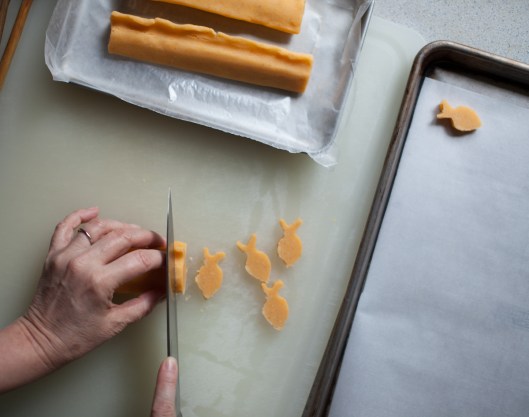
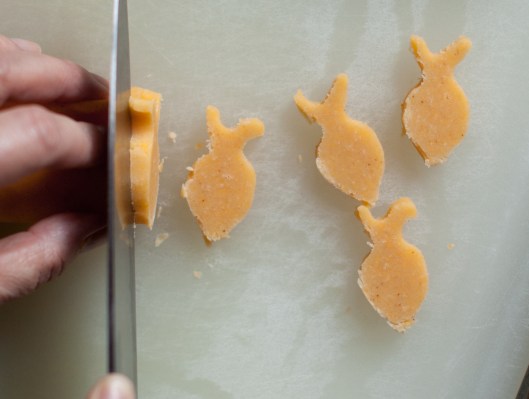
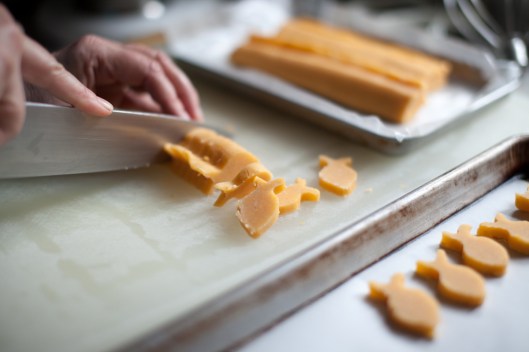
14 Using a sharp, non-serrated knife, slice the goldfish rolls about 1/4″ thick and place on a parchment-lined baking sheet. 14 Goldfish
15 15 Goldfish
16 Aren’t these cool? 16 Goldfish
17 17 Goldfish
18 18 Goldfish
19 19 Goldfish
20 The dough doesn’t raise much so the goldfish can be placed fairly close together.
Bake at 400 for 14 minutes. Cool on paper towels. 20 Goldfish
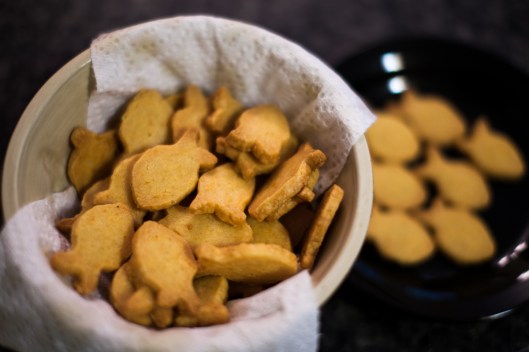
21 The Goldfish Crackers are all ready for her.
Goldfish in a bowl.

Goldfish in a bowl.


22 She walks home from school with her mom and little brother. 22 Goldfish tea day
23 And then we have tea (Apple Juice or Water) and Goldfish and Shortbread. 23 Goldfish
24 24 Goldfish
25 We ate them by the handful. None got away. 25 Goldfish

Share this:

  • Share on X (Opens in new window) X
  • Share on LinkedIn (Opens in new window) LinkedIn
  • Share on Facebook (Opens in new window) Facebook
  • Share on Pinterest (Opens in new window) Pinterest
  • Share on Reddit (Opens in new window) Reddit
  • Email a link to a friend (Opens in new window) Email
  • Print (Opens in new window) Print
  • Share on Tumblr (Opens in new window) Tumblr
Like Loading...

DIY – decorative Wrought Iron design paper

18 Thursday Jul 2013

Posted by Julia Monroe in art, crafts, handmade books, journals, mixed media, tutorial

≈ 5 Comments

Tags

coffee dyed, crafting, crafts, DIY, handmade paper, make your own, paper arts, paper crafts, tutorial

A couple months ago I made some beautiful coffee-dyed, wrought iron patterned paper completely by accident. I wanted coffee-dyed paper for a project so I boiled coffee grounds (about twice as strong as a usual pot of coffee) in water and let it steep about half an hour. I strained out most of the coffee grounds by pouring the mixture through a coffee filter and then added another couple tablespoons of instant coffee.

Even though it was spring, the sun was high in the sky and it was hot out so our cast aluminum, wrought iron-style table was hot. I figured all the heat would help the paper dry.

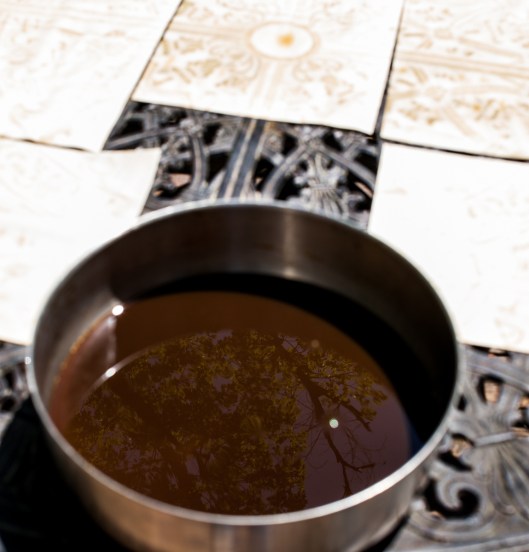
The day was bright and dry when I dyed  the wrought iron style paper. The  large pan of coffee dye was wide enough for the paper to fit comfortably.

The day was bright and and the sun was high when I dyed the paper. The large pan of coffee dye was wide enough for the paper to fit comfortably.

I dipped each sheet of drawing tablet paper into the coffee dye and let it drain a little against the edge of the pan. Within seconds of being laid on the table, the table design showed up on the paper! Here you can see the still-wet sheen of coffee on the paper.

The coffee pooled on the top of the paper and the pattern of the table magically showed up on the surface of the paper.

The coffee pooled on the top of the paper and the pattern of the table magically appeared on the surface of the paper.

I covered as much of the table as I could with the dipped paper and loved the variety of design on each sheet of paper.

The table is covered with wet paper. The edges of some sheets are already drying and curling up.

The table is covered with wet paper. The edges of some sheets are already drying and curling up.

I wish I had written down how long it took the paper to dry, perhaps half an hour. Once there were no more puddles on top, I flipped all the papers over to dry more. When I turned each sheet over, the design on the bottom looked amazing! It is beautiful on both sides but especially smooth and beautifully shaded on the bottom.

The wrought iron design on the bottom side of each sheet has a beautiful creamy color and delightful shading.

The wrought iron design on the bottom side of each sheet has a beautiful creamy color and delightful shading.

I will be using this paper to make handmade books and journals.

If you dye paper like this using a wrought iron table, please let me know how it turns out. Cast aluminum doesn’t rust so there was no rust residue on my paper. A wrought iron table might have a different effect on the paper.

The table surface was very hot. I haven’t experimented to see if this works on a cold table.

There may be coffee dripping from the paper so don’t do this over a deck surface that you don’t want brown drips on. There was very little coffee dripping from the paper because the day was hot and dry and the paper absorbed it very quickly and it didn’t matter to me if there were brown specks on my deck.

Share this:

  • Share on X (Opens in new window) X
  • Share on LinkedIn (Opens in new window) LinkedIn
  • Share on Facebook (Opens in new window) Facebook
  • Share on Pinterest (Opens in new window) Pinterest
  • Share on Reddit (Opens in new window) Reddit
  • Email a link to a friend (Opens in new window) Email
  • Print (Opens in new window) Print
  • Share on Tumblr (Opens in new window) Tumblr
Like Loading...

The Crown Journal

15 Saturday Jun 2013

Posted by Julia Monroe in All Sparkled Up, crafts, Gilded Life, handmade books, journals, tutorial

≈ 5 Comments

Tags

All Sparkled Up, bookmaking, crafts, crown, handmade book, handmade journal, journals, lace, paper crafts, tutorial

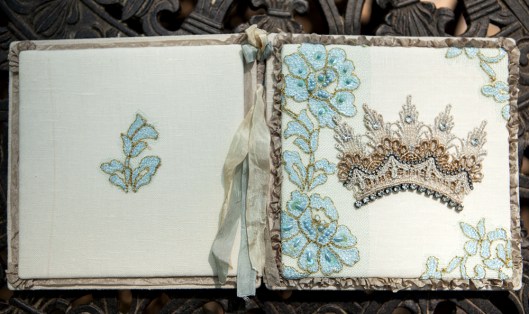
The Crown Journal.

The Crown Journal.


For years I made my own blank journals using a standard codex construction with fabric bound spine and hardcovers. The signatures were sewn onto cords or tapes and then glued into the hard cover. This site, Humblebee & Me, has an excellent tutorial for sewing signatures on tapes.

It’s been a few years since I made a handmade journal so I finally had time to make one a couple months ago. I followed Jeanne Oliver’s video for stitching the signatures together from her wonderful The Journey of Letting Go class online . (I highly recommend the class, not just for the terrific art instruction, but also for the heart-felt inspirational videos. Jeanne, you’re the best!) Jeanne’s stitching process for sewing the pages together was easy and fun.

I didn’t photograph the steps to stitch the text block together but here is how I made the Crown Journal cover if you want to make one. This is an abbreviated tutorial but there’s enough here to give you basic instruction to make the lace crown, which would look great glued to an altered book cover. If you want actual measurements, let me know in the comments and I’ll measure some of the components for you.

It was fun going through my stash of supplies to pull out some pretty options.
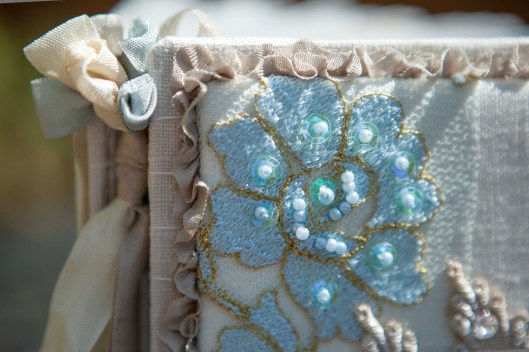
The dyed seam binding tape, blue sequin fabric, lace and rhinestone chain were from A Gilded Life.
To make the text block, I cut up a sketch pad.
The linen was purchased from sources online.
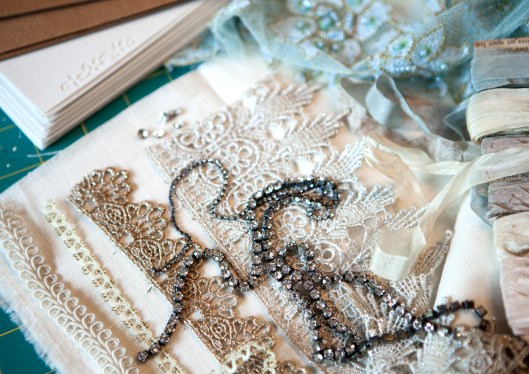
Glittery trims, lace and rhinestones to make a handmade journal.

Glittery trims, lace and rhinestones to make a handmade journal.

Both front and back covers were assembled the same way. Each cover has a piece of ivory linen and natural color linen, one small and one larger piece of chip board (cut from the back of a water color tablet) and a piece of thin cotton batting for padding under the ivory linen.

The materials used to make the book cover: Ivory linen over batting over chip board, which is then glued to a larger piece of chip board covered with natural linen.

The materials used to make the book cover: Ivory linen over batting over chip board, which is then glued to a larger piece of chip board covered with natural linen.

The batting is lightly glued to the small chip board square and then the ivory linen is placed over top of the batting. This piece is turned over and the ivory linen is glued to the back of the board, mitering the corners on the back.
The natural color linen is glued to the larger board without any batting.

Once the cover pieces are covered with linen, then you get to do the fun stuff!
I lay loose pieces of lace and rhinestone chain on the top of the book cover to see what I liked before gluing anything down.
I also tried several different lace pieces before making up my mind about the crown.
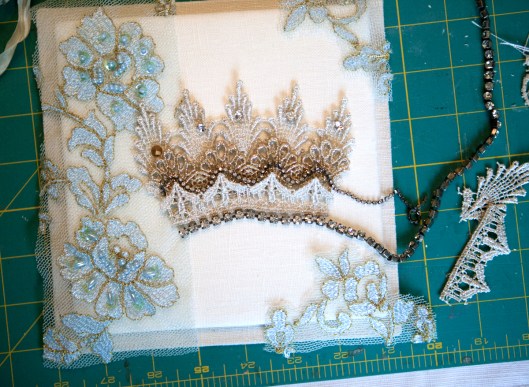
Trying out pieces of lace for the crown.

Trying out pieces of lace for the crown.

To glue such fine netting, I spread tacky glue on the flat lid of a plastic bin and then laid the blue lace in the glue… then quickly picked up the lace while still wet and smoothed it in position on the padded ivory linen.
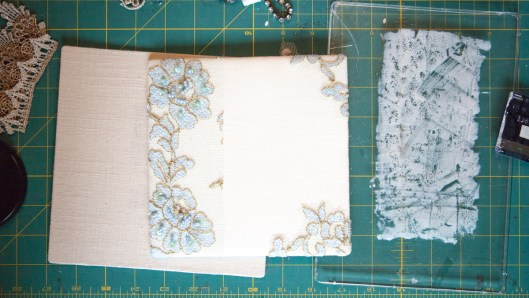
Gluing the sequined lace on the journal cover.

Gluing the sequined lace on the journal cover.

There was just enough glue on the thin lace netting to glue all the tiny pieces down securely, with no edges pulling up and no glue squishing up. I want the lace to be durable because this journal will last me at least a year.
Crown Journal-2c
The back of this board shows how the edges of the linen and lace are glued down on the back of the padded ivory board.
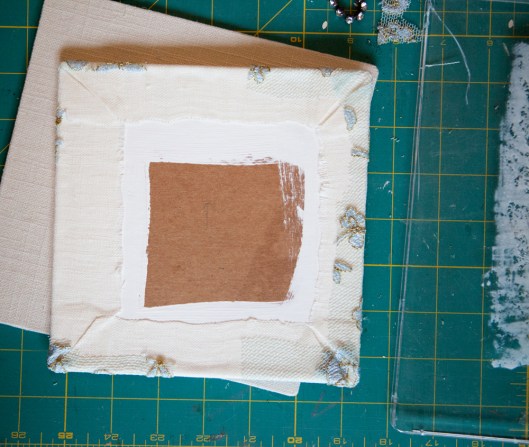
The back of the top cover piece.

The back of the top cover piece.

To make a lace crown, choose lace pieces that will look like the points of a crown when placed together. I used three different pieces of lace. To curve the lace, cut small slits between the motifs of the lace as shown.
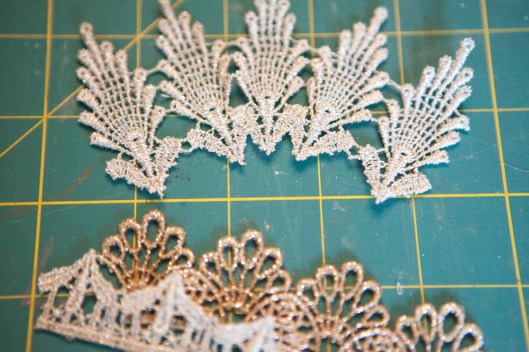
Crown Journal-3a Making the Lace Crown
Here you can see where I snip the lace so it will curve better.
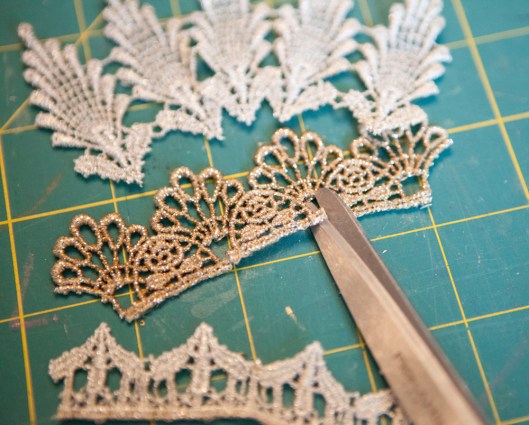
Snipping the lace so it curves better.

Snipping the lace so the edge can be overlapped so it curves better.

Once the lace is ready, glue the pieces together to form the crown.

The lace crown pieces all glued together.

The lace crown pieces all glued together.

Tacky glue is thinly spread on a smooth surface and the lace crown is carefully pressed into the glue.

The assembled crown is laid on wet tacky glue.

The assembled crown is laid on wet tacky glue.

While the glue is still wet, lift the lace crown piece up and carefully position it on the cover and press it down on the ivory linen. It dried fairly fast when I positioned it but I still pressed down in places to make sure it stuck well on all edges.

The crown is carefully positioned on the book cover and pressed down around all edges.

The crown is carefully positioned on the book cover and pressed down around all edges.

Cut rhinestone chain to size using jewelry cutters and glue it down with 527 Multi-Use glue or other strong jewelry glue.

Jewelry cutters are used to cut the rhinestone chain to size.

Jewelry cutters are used to cut the rhinestone chain to size.

I pressed my needle nose pliers into the book cover to make small indentations so rhinestones would set in deeper and more securely. These were glued with the 527 glue also.

If the gems are large, make a small indentation so they can be set more securely into the book cover.

If the gems are large, make small indentations so they can be set more securely into the book cover.

The crown is complete.
Crown Journal-4c
The front of the book cover is ready for the next step.
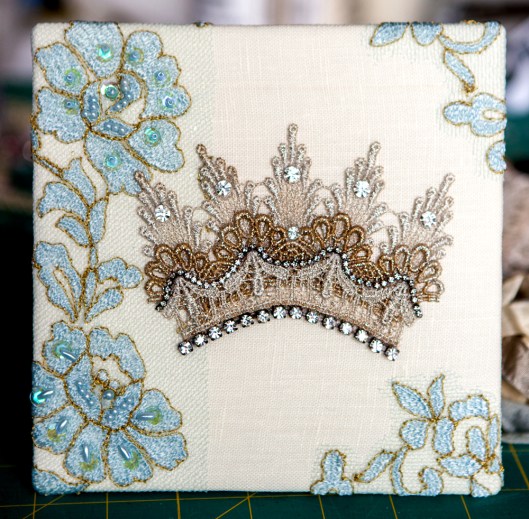
Crown Journal-4d
While the glue was drying, I made the ribbon rose buds for the journal spine. A length of ribbon was tied to make a loose knotted ribbon rose bud. I made three of these.
To make a knotted rose bud, the ribbon is tied as if about to make a knot, but the ribbon is looped over and over 4 times, not just once like a standard knot. Then when the ribbon is slowly pulled tighter, the layers of wrapped ribbon overlap and form a pretty bud shape. If the ribbon is pulled too tightly, the flower shape disappears and turns into a big knot. So you have to stop pulling while the ribbon is still loose. The ribbon “tails” are folded to the back and then stitched together so the ribbon bud doesn’t come apart. I cut off the excess ribbon and gently fringed the short ribbon tail under the bud.
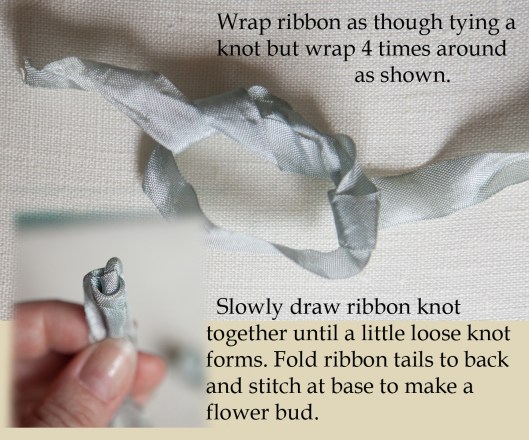
Making the ribbon rose buds.

Making the ribbon rose buds.

Three lengths of ribbon were stitched and gathered together.
Crown Journal-5b
These longer ribbons were stitched behind the flower buds.

The ribbon loops are sewn to the back of the ribbon rose buds.

The ribbon loops are sewn to the back of the ribbon rose buds.

I ruffled a long length of seam binding tape to use on the front cover. Here it is pinned down on the larger natural linen-covered board as I adjust the ruffles to fit. But before gluing down the ruffle, I glued on the decorative top of the cover.
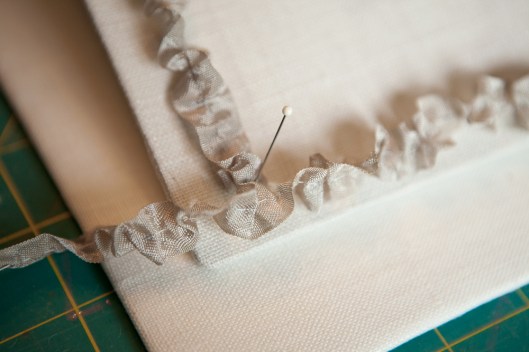
Seam binding tape is gathered down the middle and the pinned to the cover to check for size and adjust ruffles.

Seam binding tape is gathered down the middle and then pinned to the cover to check for size and adjust ruffles.

I spread tacky glue generously over the back of the ivory cover piece and pressed it down on the larger board.

Glue is squirted on the inside of the top cover piece. After taking this photo, I spread the clue around using an old credit card and made sure the glue extended all the way to the edges and corners.

Tacky glue is squirted on the inside of the top cover piece. After taking this photo, I spread the glue around using an old credit card and made sure the glue extended all the way to the edges and corners. Tacky glue is great because it sets up fast but you have to work quickly.

Some of the glue squished out around the edge but that was good. I used my fingers and a pallet knife to press the folded ruffle into the glue. I used the ruffle folded in half all the way down the length for extra fullness. It was easy to press the center of the ruffled seam binding tape into the glue and it held well. I squeezed more tacky glue into any spaces that didn’t have enough to hold the ruffle well.

The top of the cover is glued on the larger linen-covered board. Then while the glue is still wet, the ruffled seam binding tape is pushed into glue.

The top of the cover is glued on the larger linen-covered board. Then while the glue is still wet, the ruffled seam binding tape is pushed into wet glue between the two boards.

The back cover was different. Instead of a ruffle all the way around, I just pleated the four corners and let the seam binding tape stay flat on the sides. I glued this down before gluing on the back piece.
Crown Journal-7a
I cut a small motif from the blue lace and laid it in glue as for the front cover.
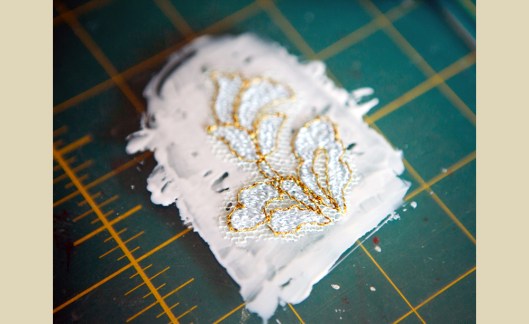
Crown Journal-7b
The glued motif was positioned and pressed down carefully, especially around the lace edges. Here is the finished back cover.
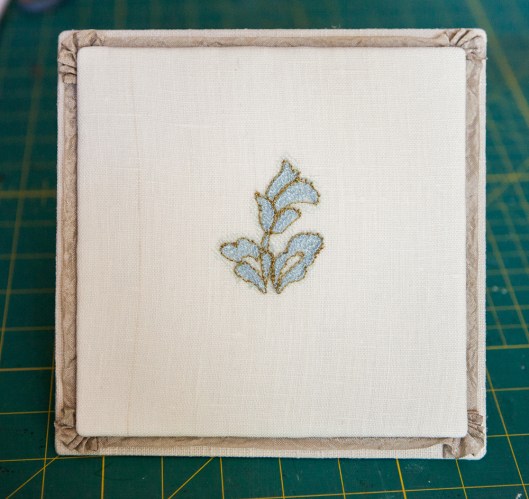
Crown Journal-7c
I glued a piece of decorative paper inside the front and back covers to cover the edges of the linen and lace. The same kind of paper was used to wrap the front and back signatures so they would match.
Crown Journal-8a
Each signature was folded inside a piece of vintage wallpaper or decorative paper. Here you can see the gap between two signatures in the journal.
Crown Journal-8b
I accidentally placed this piece of wallpaper upside down during construction of the journal. I don’t mind because mistakes like this make me smile and remind me life isn’t perfect.
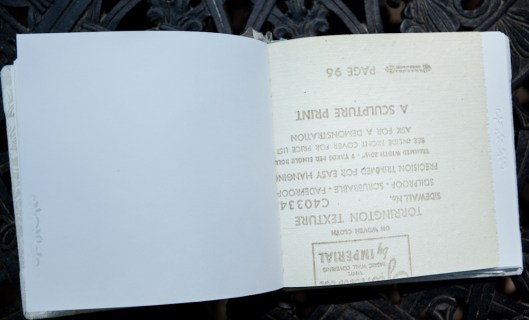
Crown Journal-8c
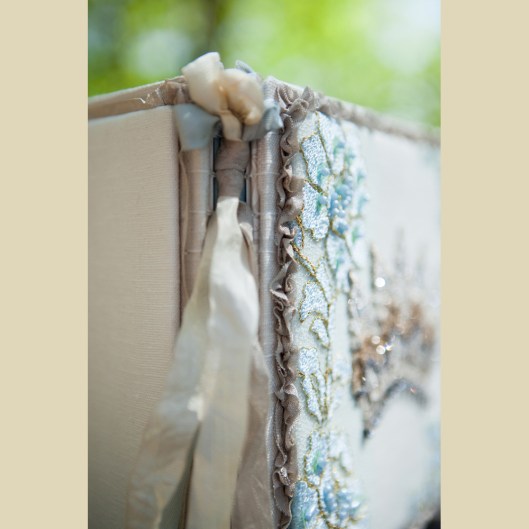
Once the book was sewn together, I stitched and glued the bundle of ribbon rose buds into the spine.
Crown Journal-9a
Crown Journal-9b
Here you can see the stitching along the spine.
Crown Journal-10
The bundle of rose buds in the spine doesn’t interfere with the book opening fully.
Crown Journal-11
I used a decorative paper punch to punch the edges of pages in random places.
Crown Journal-12
One of the ribbons is threaded in between two signatures to be used as a ribbon bookmark.
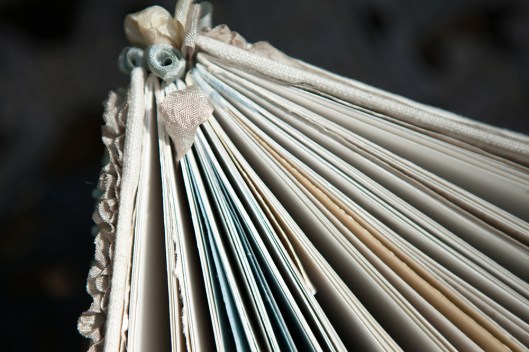
One of the ribbons at the spine is used as a bookmark.

One of the ribbons at the spine is used as a bookmark.

Crown Journal-15

The finished Crown Journal.

Crown Journal-14

The binding of this book allows it to open fully, even with a ribbon bundle glued and sewn into the spine.

This journal will last me about a year because I tend to write very small. I’ve been using it for two months so far and it has shown no signs of loosening and all the lace and gems are glued down tight, even when I slide the journal between books on a bookshelf.

I have to confess that this is the prettiest journal I’ve had in a long time. It’s quite heavy and the covers are soft and silky to hold. All the prettiness has had an unexpected impact on me. Each night, when I pick it up to write, I noticed that my writings have become more optimistic. I’m really glad about that because I have a couple old journals that are genuine but much too sad to reread. This is the perfect journal for this time in my life, a time of transition and full of good things, all sparkled up.
Share this:

  • Share on X (Opens in new window) X
  • Share on LinkedIn (Opens in new window) LinkedIn
  • Share on Facebook (Opens in new window) Facebook
  • Share on Pinterest (Opens in new window) Pinterest
  • Share on Reddit (Opens in new window) Reddit
  • Email a link to a friend (Opens in new window) Email
  • Print (Opens in new window) Print
  • Share on Tumblr (Opens in new window) Tumblr
Like Loading...

The Moss Rose Bracelet is finished

07 Friday Jun 2013

Posted by Julia Monroe in All Sparkled Up, beading, crafts, jewelry making, projects, sparkling, tea time, tutorial

≈ 4 Comments

Tags

beading, beads, crafts, flower beads, jewelry, jewelry making, Moss Rose, moss rose bracelet, tutorial, vintage beads

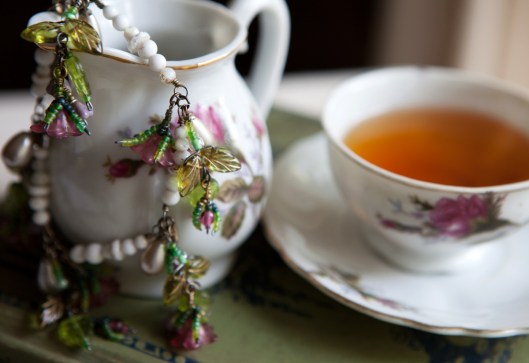
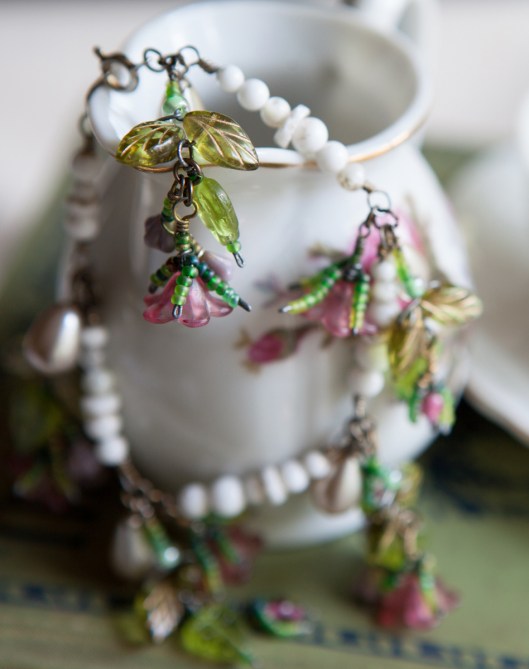
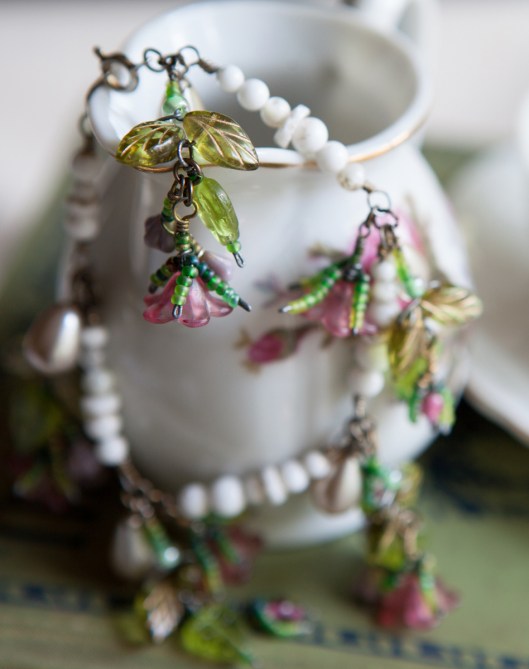
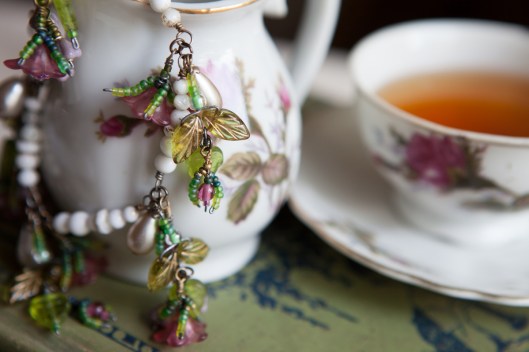
The Moss Rose Bracelet, inspired by an antique tea set from my Grandma, is finished and I love it! It turned out even better than I expected. ..happy smile…

Moss Rose Bracelet, inspired by a vintage teacup from my Grandma.

Moss Rose Bracelet, inspired by an antique tea set from my Grandma.

There are three things special about this bracelet. First, the colors truly say Moss Rose.
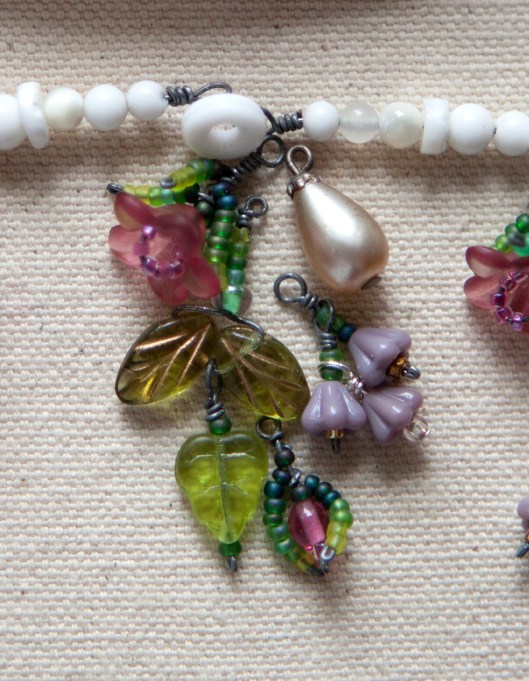
I was working from my stash of beads from French General, A Gilded Life and vintage beads and wasn’t sure I had all the right colors. Without intention, my love of Moss Rose must have influenced my purchase of beads over the years because I just happened to have the right colors. How cool is that! I had dark mossy greens, deep pinks and the perfect little dusty lavender cone flower beads. I was most particular about the white beads, which had to look like old white china. I didn’t have any rose beads but that was ok since all I really needed was the impression of a rose. I used Lucite trumpet flower beads with a bead calyx and that worked well.

Moss Rose Bracelet components

Moss Rose Bracelet components

Second was the movement of the bracelet. Necklaces lay fairly still around the neck but bracelets have to move. They need shimmy and jingle, drape and sway, elegant like ballet. Bracelets need movement just distracting enough to be noticed. The Moss Rose Bracelet does exactly what I hoped it would do; the roses and leaves drip down and sway gently against my arm.

I love how loose and draping the leaves are on this bracelet.

I love how loose and draping the leaves are on this bracelet.

Third and best is how much the bracelet makes me think of my Grandma and my mom. Some of the beautiful china-white beads are from a broken necklace that belonged to my mom. So special. ♥

Even though I’m making a few of these bracelets to sell in my Etsy shop, I want to share how I made some of the components. I have not included directions for making the small clusters of purple flowers because some Moss Rose patterns do not have these flowers. But you can see how they were constructed by looking closely at the photos.

Make the “roses”
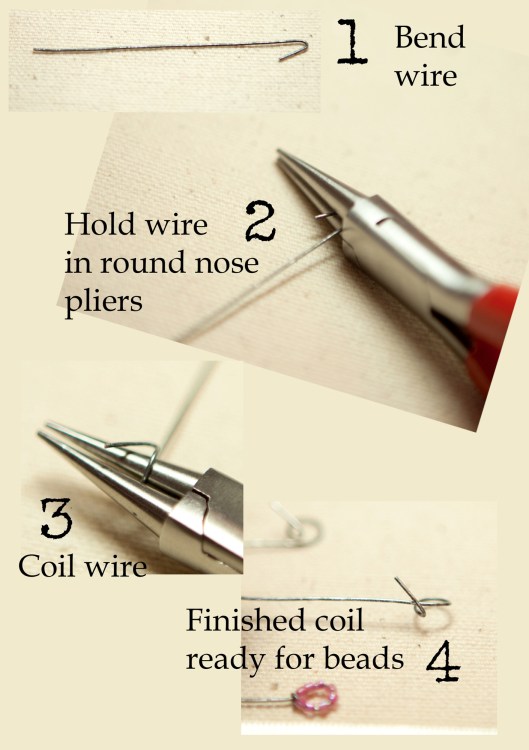
To make a rose, prepare the wires for the flower centers.
1. Bend 1/4″ at the end of a 2 1/2″ piece of jewelry wire.
2. Hold the bent part of the wire in round nose pliers.
3. Coil the wire using the round nose pliers. As the coil is formed, you will have to move the bent tail out of the way until a full coil is formed. It’s hard to explain but you’ll see what I mean as you bend the wire.
4. The finished coil, ready for seed beads.

Prepare the wires for the rose centers.

Prepare the wires for the rose centers.

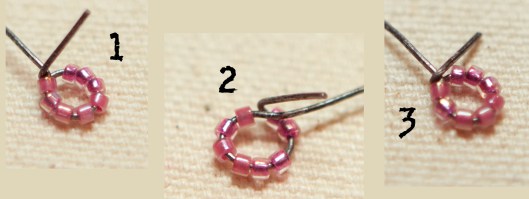
Add about 8 seed beads to the wire.

1. Slide the beads onto the wire and into the coil.
2. Make sure all the beads are in the coil and then bend the tail of the wire over.
3. Use needle nose pliers to fold the tail tightly around the wire as shown. Cut off the short tail close to the center wire using flush cutters.

Add beads to the flower center wire loop.

Secure seed beads to the flower center wire loop.

Shown here are all the steps to make a flower center.
Moss Rose Bracelet Tutorial 3

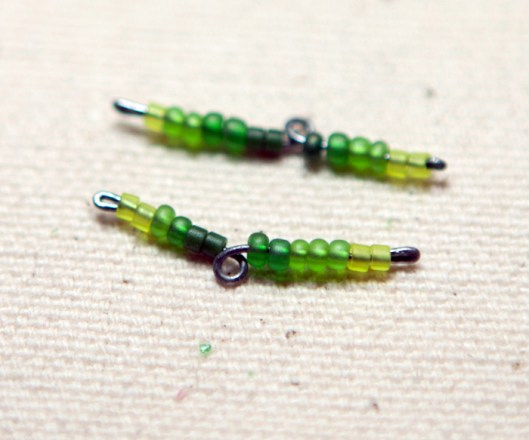
Prepare the beaded Calyx wires.
Start with a 1 1/4″ piece of wire.You can use head pins for this but I didn’t have enough so I made my own by tightly folding in 1/16″ of wire at the end. Two calyx wires are used for each rose and one for each rose bud. I varied the length of these to make the mossy roses and buds more realistic and natural looking. The color of green seed beads are placed in a light to dark to light pattern on each wire.
[NOTE: The photos show the way I made the wires first. But I had a few broken seed beads when I twisted the center of each calyx wire after the seed beads had been added. The better way would be to form the center loop first, then slide beads onto each side, and then fold the tip of the wire in to secure the beads. I don’t have photos of bending the wires that way but these photos will give you an idea of the finished product.]

Secure green seed beads on wires to use for the calyx.

Secure green seed beads on wires to use for the calyx.

The components to make a rose are two calyx wires, a trumpet bead flower and a round beaded wire center.

Components used in making a "rose".

Components used in making a “rose”.

Insert the flower center into a flower bead.  Slide the green beads apart at the center and bend the calyx wires in half.

Insert the flower center into a flower bead. Using round nose pliers, bend the calyx wires in half and then bend until you have a tiny loop.

Two beaded wires ready to place on the flower wire.

Two beaded wires ready to place on the flower wire.

Moss Rose Bracelet Tutorial 8
Slide the calyx wires one at a time down over the flower. Twist a little tighter to make the calyx secure. That’s ok if they move a little. Remember, if you twist too tight, you might break some of the seed beads. It might be easier to make these directly on the flower wire so as to avoid any seed beads breaking. I will probably try that next time although this worked well enough.
Moss Rose Bracelet Tutorial 9

Moss Rose Bracelet Tutorial 10
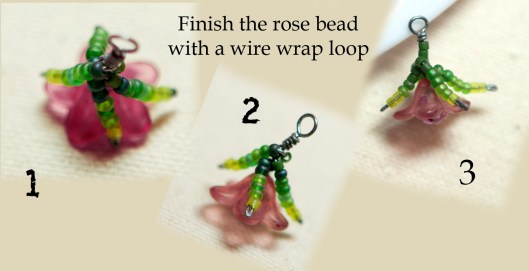
I finished some of the flowers with just a wire wrapped loop. But others I added seed beads to make a slightly longer stem before finishing with a wire wrapped loop.

Make the rose buds
1. Make Calyxes as above, one per rose bud.
2. Slide a pink seed bead and then a 4 mm round pink bead on a 2″ wire with folded end or use a head pin. Then add a dark green seed bead. Slide the prepared beaded calyx wire over the round bead as you did for the flowers.
3. Add more seed beads to the wire and finish with a wire wrapped loop. I slightly spiraled the calyx wires around the 4mm bead.
Moss Rose Bracelet Tutorial 11

Make the rose leaf clusters
Oh my goodness, I got so excited the night I figured out how to wire these! I was shutting down for the night and was staring at my work table, not seeing the beads. I was actually praying for some family members in distress and not even thinking of beading. Then all of a sudden I figured out how to wire the leaves together so they would dangle the way I hoped. God is so cool to give us ideas when we least expect it.
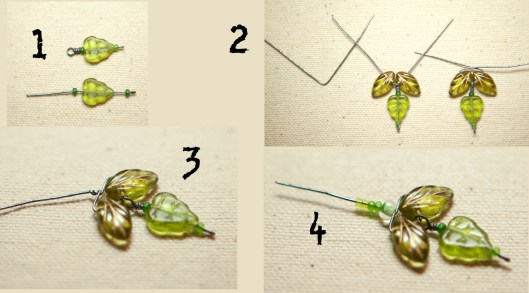
1. Prepare the center bead by sliding a seed bead, then a pressed glass leaf bead, then another seed bead on a 2″ wire with folded end or head pin. Finish with a wire-wrapped loop and set aside.
2. Cut a 3″ piece of wire and bend at a 90 degree angle as shown.
Slide the center bead you made down to the angle in the 3″ wire.
Slide a leaf bead on each side of the center bead.
Fold the wires toward the center of the two beads. The wires will cross over. Where the wires cross over, twist the wires together at the top, as in photo 3. Be careful you don’t twist too tight or you may shatter the leaf beads. I didn’t break any but I know that’s a possibility if you make the twist too tight.
3. Cut one of the wires with a flush cutter as shown so you have a single wire remaining. The twist should be tight so that it will fit inside a bead in the next step. Click on the photo and then click the number link at the upper left of the photo to view the original size image to see a close up of the construction.
4. Slide a larger bead with a hole big enough to cover the twisted wires. Add a couple more seed beads on the remaining wire. Finish with a wire wrapped loop.
Moss Rose Bracelet Tutorial 12

Gilding
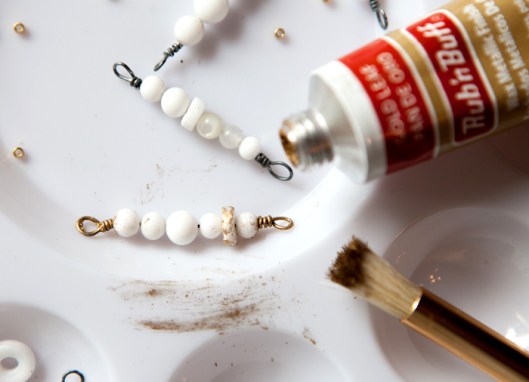
The Moss Rose tea set I have has a delicate border of gold, much of it worn off by age. I duplicated that touch of gold by using Rub n Buff and a stiff brush to add a touch of gold to the some of the white beads and wire findings on the bracelet components.
Moss Rose Bracelet Tutorial 13
Here are the beads all ready for assembly. I moved them around on the table a bit until I came up with a design I liked. I ended up not using the little white doughnut beads but it was fun to have options.

Moss Rose Bracelet Tutorial 14
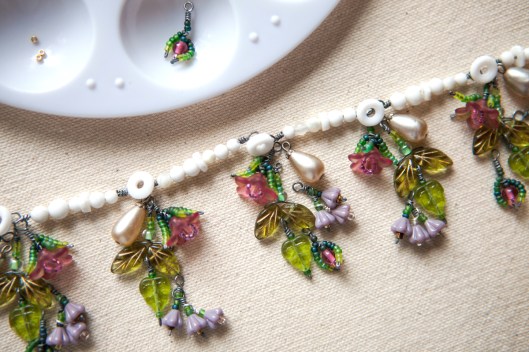
The bracelet is finally assembled using jump rings to attach all the pieces together.
Moss Rose Bracelet Tutorial 15

Moss Rose Bracelet Tutorial 17

Moss Rose Bracelet Tutorial 18

Thank you for visiting my blog. I truly appreciate it! Blog readers get just little glimpses into our lives; they see splashes of color, tangles of wire, components lined up but not always connected. I really appreciate your faithfulness as I figure out how to make this blog better for you.

In the beginning of this blog, I didn’t have any readers at all but merrily posted away like a little bird chirping in a forest. Then I went through a rough time after breaking my back and getting major surgery, with its months of medicated pain management. Over the past year my posts weren’t always happy. But I have come to value life and the beautiful people in it more than ever.

This blog is for you. Like tending a garden of roses, I’ve done some weeding and deleting here. What is left are posts I hope have value, and the ones written when I did my best to be brave. I’m learning how important it is to stay true to the sparkling things in life and share the best. I guess we all grow in grace like that. I want to give you something good because your presence here reading my blog is a gift of pure grace. Thank you.

May grace adorn your life, with all the splendor you hoped for.
Love to you, my dear readers!

Share this:

  • Share on X (Opens in new window) X
  • Share on LinkedIn (Opens in new window) LinkedIn
  • Share on Facebook (Opens in new window) Facebook
  • Share on Pinterest (Opens in new window) Pinterest
  • Share on Reddit (Opens in new window) Reddit
  • Email a link to a friend (Opens in new window) Email
  • Print (Opens in new window) Print
  • Share on Tumblr (Opens in new window) Tumblr
Like Loading...

We made up a new recipe – PB & Jam Joconde Cake – Part 4

30 Saturday Mar 2013

Posted by Julia Monroe in baking, food, recipe, tutorial

≈ 3 Comments

Tags

cake, dessert, food, joconde, mousse, PB & J, Peanut Butter, recipe, sponge cake

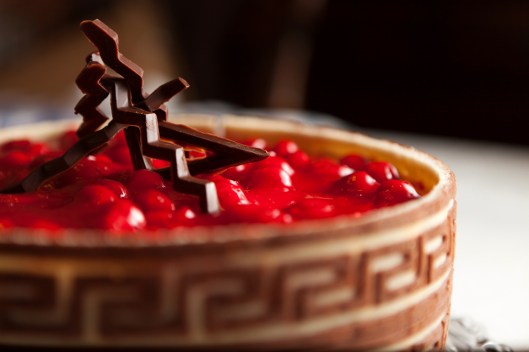
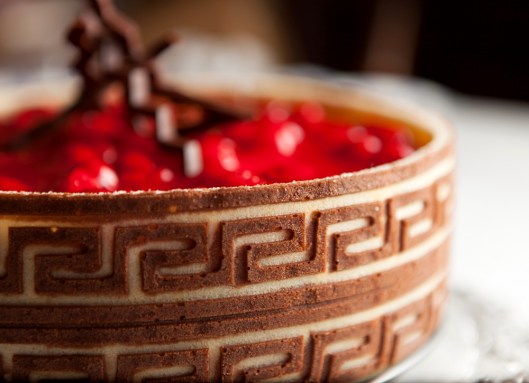
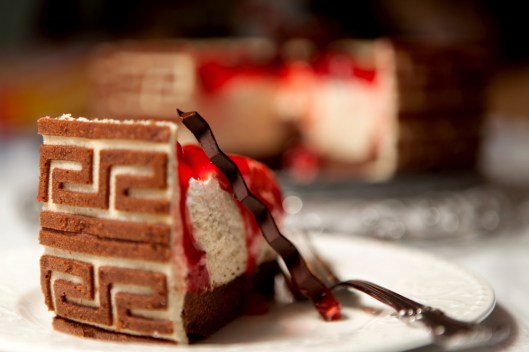
    PB & J Joconde - Almond Sponge Cake wrapped around a layer of Chocolate Almond Sponge cake under a thick layer of Peanut Butter Cream Cheese Mousse and topped with Cherry Topping.

PB & J Joconde – Almond Sponge Cake wrapped around a layer of Chocolate Almond Sponge cake under a thick layer of Peanut Butter Cream Cheese Mousse and topped with Cherry Topping.

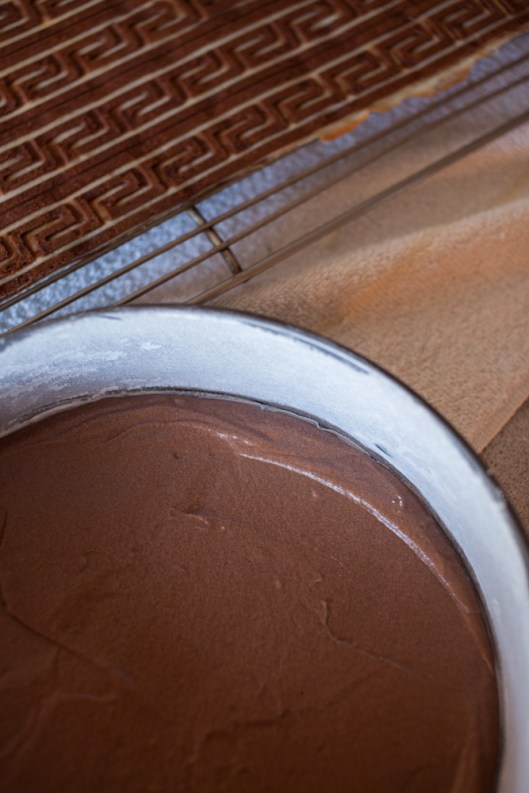
After the pan was lined with the joconde strip and cake, we made a batch of Peanut Butter Mousse. I’ve made vanilla and chocolate mousses many times so I just adapted a vanilla mousse with the addition of peanut butter and cream cheese.

Peanut Butter Mousse
1 pkg + 1 tsp gelatin softened in 3 Tbsp water.
6 Tbsp boiling water
1/2 cup granulated sugar
1/4 cup brown sugar
3 cups heavy whipping cream
1 tsp vanilla extract
8 oz cream cheese
2/3 cup peanut butter

Stir the boiling water into the softened gelatin. Stir till dissolved. Set aside.
Beat sugar, whipping cream and vanilla until softly mounding.
Beat the cream cheese with the peanut butter until smooth.
Beat a little whipping cream into the cream cheese peanut butter mixture. Beat in the rest of the whipping cream until almost stiff.
Gradually add the gelatin mixture to the whipped cream mixture. Do NOT overbeat or the mixture will turn grainy.
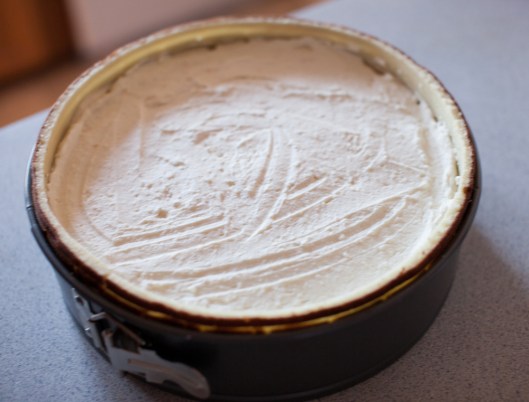
Spread the Peanut Butter Mousse in the prepared pan.

I made mousse but I didn't measure all the ingredients. It wasn't peanut buttery enough so next time I will add more peanut butter.

When I made the mousse for this, I didn’t measure the peanut butter but it was about 1/3 cup. It wasn’t peanut-buttery enough so I made a second batch with 2/3 cup peanut butter (as in the recipe in this post) and that was much better.

PB & J Joconde-36

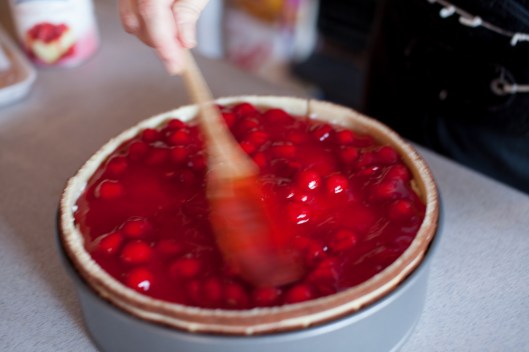
I didn’t have any fresh fruit to make a jam topping so I used cherry pie filling. A fresh Crushed Blueberry Sauce would have been divine!

PB & J Joconde-37

The finished cake was placed in the refrigerator for several hours. Six hours would have been better and made the cake slice better.

PB & J Joconde-38

The cake is taken out of the springform pan.

PB & J Joconde-39

I used a candy mold to make the chocolate shapes from Ghiradelli Bittersweet Chocolate.

PB & J Joconde-40

PB & J Joconde-41
PB & J Joconde-43

PB & J Joconde-42

There were rave reviews over our first Joconde cake. PB & Jam, dressed up to the max!

I’m looking forward to making a Lemon Almond Sponge with Pineapple Cream Cheese Mousse and Pineapple Mandarin Topping. Also a Raspberry rendition. And perhaps three crisp hazelnut dacquoise layers with coffee cream filling. The joconde was good just plain so we’ll be using the mat to develop some bar cookie recipes as well. All in all, we are very satisified with our first joconde cake.

Share this:

  • Share on X (Opens in new window) X
  • Share on LinkedIn (Opens in new window) LinkedIn
  • Share on Facebook (Opens in new window) Facebook
  • Share on Pinterest (Opens in new window) Pinterest
  • Share on Reddit (Opens in new window) Reddit
  • Email a link to a friend (Opens in new window) Email
  • Print (Opens in new window) Print
  • Share on Tumblr (Opens in new window) Tumblr
Like Loading...

We made up a new recipe – PB & Jam Joconde Cake – Part 3

29 Friday Mar 2013

Posted by Julia Monroe in baking, food, tutorial

≈ 2 Comments

Tags

cake, dessert, food, joconde, mousse, PB & J

— PB & Jam Joconde – continued from Part 2 —

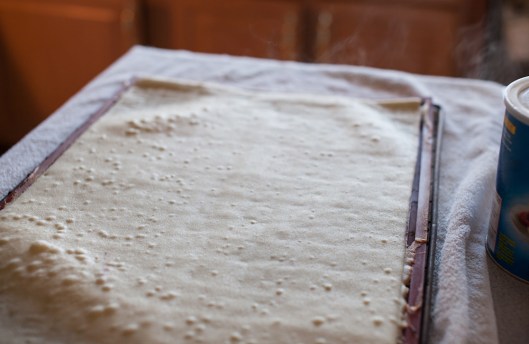
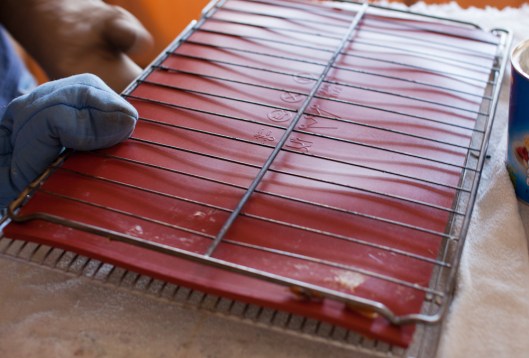
The beautiful baking mat filled with dough fit our oven wall to wall, with barely room to spare when we first put it in the oven. After a mere 7 minutes baking at 450, smoke started pouring out of the oven. We threw open the oven door to see the mat had swelled up and was buckled and spreading up the sides of the oven! We were so relieved that the mat wasn’t on fire or melting. But some of the batter was burning on the sides and bottom of the oven. No time for photos, we grabbed the oven mits and wrestled the oven rack and huge mat out.

The steaming cake is placed on the counter.

The steaming cake is placed on the counter.

PB & J Joconde-20

We’re still trying to figure out what caused the gently rolling hills on the cake since we had spread the batter fairly evenly. Most likely it was caused when the mat started climbing the oven walls and the batter pooled.

The next time we bake a joconde in our little oven, we’ll try a lower temp, maybe 400 or even 385 degrees since the mat completely cuts off circulation, especially when it swells with the heat. In order to maintain some heat above the mat, we might try starting the oven at 425, quickly putting the rack and mat in but then immediately lowering the temp to 385.

PB & J Joconde-21

A greased cooling rack was placed over the cake.

PB & J Joconde-22

The oven rack, mat and cooling rack are lifted together and flipped.

PB & J Joconde-23

PB & J Joconde-24

The mat quickly began to shrink down after being removed from the oven. But you can clearly see how it is still larger than the oven rack. The mat was still very hot here.

PB & J Joconde-25

The siliconed mat was easy to roll back off the cake. The mat was still so hot that I dropped it back on the cake immediately after this photo was taken. We had to use oven mitts to lift it off the cake.

PB & J Joconde-26

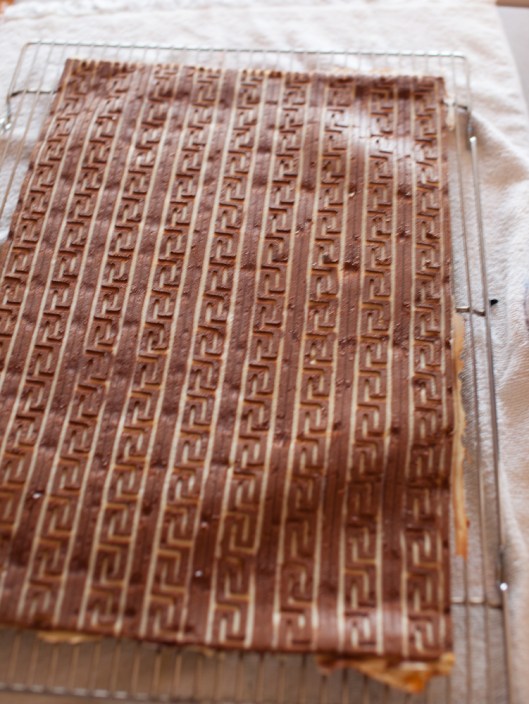
Blurry photo but Oh what a Beautiful sight! We were stoked that the joconde was a success, rolling hills, singed edges and all. I let out a whoop of joy!

We mixed any leftover chocolate and almond batters together and spread them in a 9.5" springform pan.

We mixed the leftover chocolate and almond batters together and spread them in a 9.5″ springform pan and baked it. It made a cake layer about 1″ thick.

PB & J Joconde-28

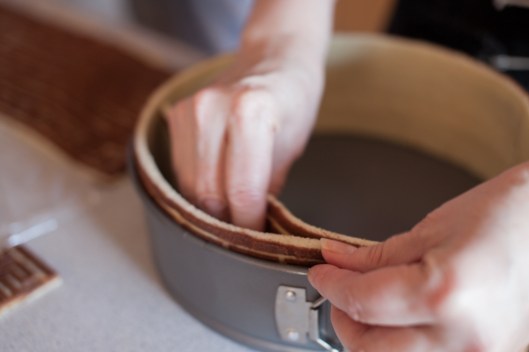
The first strip of jaconde is cut and placed against the edge of the cool springform pan.

PB & J Joconde-29

PB & J Joconde-30

A second strip of joconde is placed in the pan to fill the gap.

PB & J Joconde-31

PB & J Joconde-32

Here I cut off the excess joconde with a sharp knife.

PB & J Joconde-33

The pan lined with joconde.

PB & J Joconde-34

The cake layer is carefully lowered and pressed into the bottom of the lined pan.

—Up next, the filling of the prepared pan with Peanut Butter Cream Cheese Mousse and Cherry Topping in final Part 4!

Share this:

  • Share on X (Opens in new window) X
  • Share on LinkedIn (Opens in new window) LinkedIn
  • Share on Facebook (Opens in new window) Facebook
  • Share on Pinterest (Opens in new window) Pinterest
  • Share on Reddit (Opens in new window) Reddit
  • Email a link to a friend (Opens in new window) Email
  • Print (Opens in new window) Print
  • Share on Tumblr (Opens in new window) Tumblr
Like Loading...

We made up a new recipe – PB & Jam Joconde – Part 2

28 Thursday Mar 2013

Posted by Julia Monroe in baking, food, recipe, tutorial

≈ 3 Comments

Tags

cake, dessert, food, joconde, mousse, PB & J

— Continued from Part 1 —

Continuing our PB & Jam Joconde, we had a large baking mat, the size of the entire oven rack, filled with chocolate batter that needed chilled. If we were an actual bakery, we would waltz our carefully prepped mat into the walk-in freezer and park it between the charlottes and wedding cake layers. But we’re not a bakery, we’re just a little family kitchen with a family size fridge with shelves that barely hold a fat turkey. So we had to get creative.

We figured that the object of freezing the batter was to make it firm enough to quickly spread a second layer of batter on without disturbing the design underneath. Freezing was out so we went for a good chill.

PB & J Joconde-8

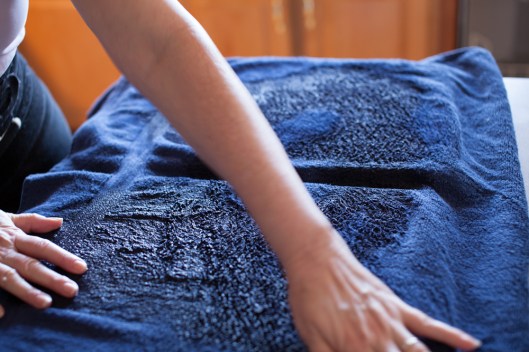
We placed a towel on the counter and covered it with ice cubes. Then we placed two half-sheet pans over the ice. This made a very cold surface on which to place the batter-filled mat.

PB & J Joconde-9

But the oven rack under the mat created too big a gap between our cold source and the baking mat.

PB & J Joconde-11

We didn’t want to remove the oven rack lest it disturb the surface of the chocolate batter so we placed a wet towel on top of the cookie sheets to transfer more cold up through the rack.

PB & J Joconde-12

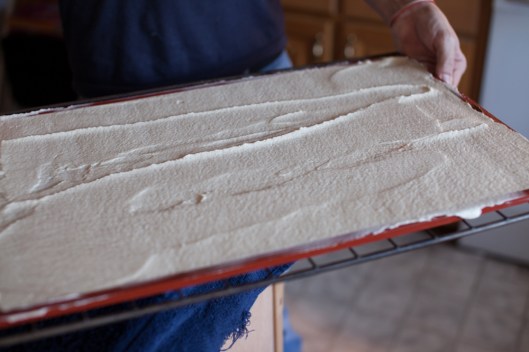
The wet cold towel worked and the mat and batter became cold. It wasn’t frozen but it was cold enough to stabilize the chocolate batter before topping it with the second layer.

PB & J Joconde-13

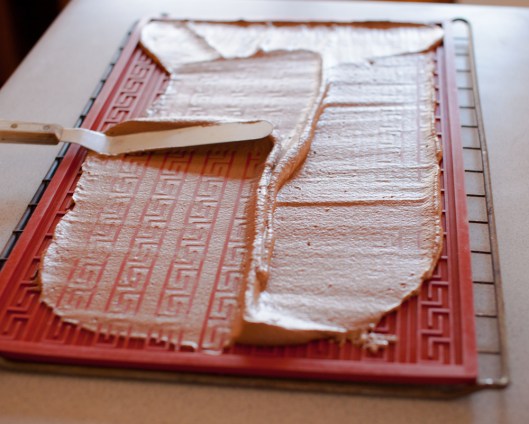
A second batch of batter was made but without the addition of cocoa. (Note here how large the baking mat is. It is almost the size of our oven rack. The fit in the oven will be tight.)

PB & J Joconde-14

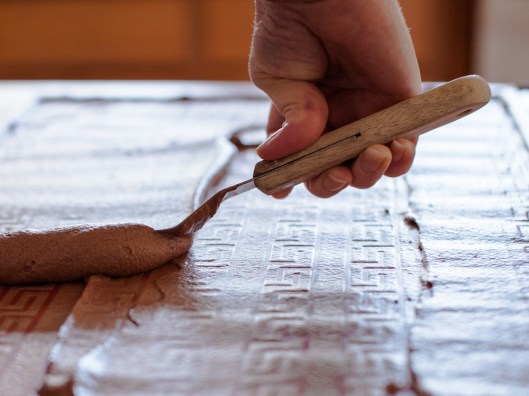
To spread the top layer of almond batter without disturbing the chocolate batter, it was critical to push the batter over the chocolate layer without spreading back and forth, which would have stirred up the chocolate batter. This step was similar to the technique used in crumb-coating a cake.

PB & J Joconde-15

PB & J Joconde-16

Finally the mat was filled and ready for the oven.

PB & J Joconde-17

The mat still on the oven rack was slid into the oven. The batter was stiff and cold so it didn’t run out of the pan.

PB & J Joconde-18

A very tight fit indeed!

And then came the baking and our THIRD MAJOR Obstacle. If I recall, we figured 10 minutes at 450 should do it. But by the time we hit 7 minutes, smoke started pouring out of the oven. “The mat must be burning!” I yelled. “Maybe it’s melting!” he responded. “I told you the cake might burn.” he insisted. We threw open the oven in a panic and discovered ….

— To be continued in Part 3 —

Share this:

  • Share on X (Opens in new window) X
  • Share on LinkedIn (Opens in new window) LinkedIn
  • Share on Facebook (Opens in new window) Facebook
  • Share on Pinterest (Opens in new window) Pinterest
  • Share on Reddit (Opens in new window) Reddit
  • Email a link to a friend (Opens in new window) Email
  • Print (Opens in new window) Print
  • Share on Tumblr (Opens in new window) Tumblr
Like Loading...

We made up a new recipe – PB & Jam Joconde – Part 1

28 Thursday Mar 2013

Posted by Julia Monroe in baking, food, tutorial

≈ 1 Comment

Tags

cake, dessert, food, joconde, mousse, PB & J, Peanut Butter

There are 43 photos with this entire post so I’ve decided to divide it up into 4 parts. I will post over the next several days so as not to slow down your connection.

A Joconde cake is a delicious, decorative almond sponge cake wrapped around layers of mousse, cake, fruit or other filling. I first discovered Joconde cakes online while surfing for baking equipment. Oh my, I did a double take at the amazing artistry of such a dessert! I didn’t know what it was called, I just knew I had to make one.

[Note about the photos: Two of my sons and I took photos of the process of making this cake. Please excuse the inconsistency in focus and style. My guys were great to kindly photograph when my hands were battered up. It’s important to me that skills are passed on to the next generation. So whenever possible, the guys get to do the fun stuff! And wow, their photos are great!]

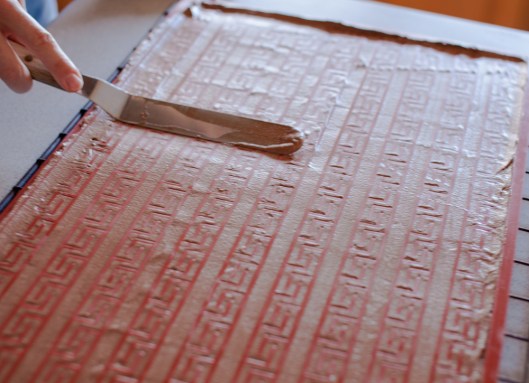
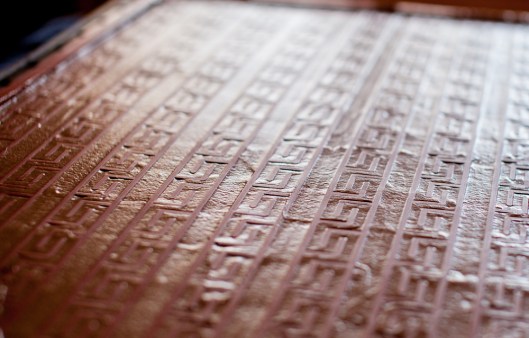
We got the silicon baking mat from Laguna Wholesale. I chose a mat with a design that had the biggest “wow” factor for me, a geometric Greek Design with precise lines and sharp detail.

Even before beginning to bake, we hit our First Major Obstacle. We’re not a bakery, we’re just a regular family that likes to bake. And our oven is a regular home oven that happily obliges. The mat purchased was 23.64 x 15.76 x 1.18 inches. I should have measured my oven before buying the mat but was just too excited.

I have no pans that size to hold the mat. We considered making a custom pan since the guys can work with sheet metal. We considered cutting the mat in half and placing each half in a half-sheet pan. (Considering the expense of the mat, that was our very last and desperate option.) We considered covering a piece of cardboard with tin foil but weren’t sure if that would affect the heat under the mat too much. Finally, we decided to use just the oven rack itself. It was a risky tight fit, with barely 1/4″ clearance on the sides but we decided to go for it before trying something else.

I found various recipes online and then created one I figured would work. I’m very disappointed in myself for losing the recipe I scratched out on a piece of paper! I decided to use just egg whites instead of whole eggs and we didn’t have almonds so I used almond extract and extra flour for best batter consistency. The batter worked fairly well.

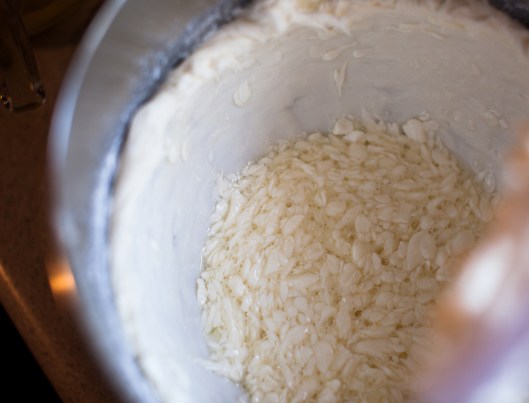
Unsalted butter and egg whites are beaten together for the first part of mixing the batter. I took this photo just because I loved how the slippery butter bits swooshed around the bowl of egg whites.

Unsalted butter and egg whites are beaten together for the first part of mixing the batter. I took this photo just because I loved how the slippery butter bits swooshed around the bowl of egg whites.

PB & J Joconde-2

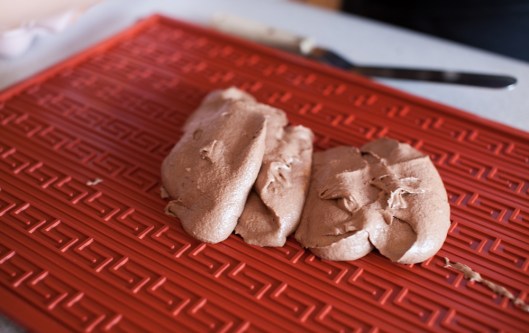
About a third cup of Dutch processed cocoa powder was beat into the finished batter then dolloped on the mat.

PB & J Joconde-3

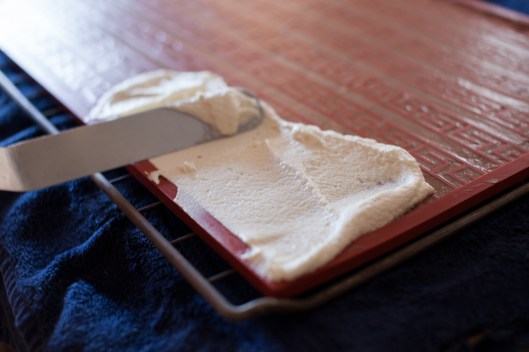
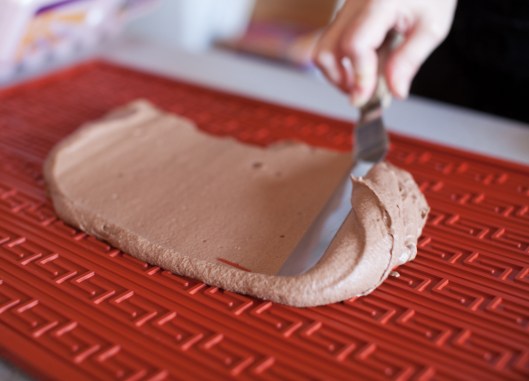
The cocoa batter was spread on the mat with a large offset spatula.

PB & J Joconde-4

We spread the batter carefully into the design, hoping to press out bubbles.

PB & J Joconde-5

PB & J Joconde-6

PB & J Joconde-7

After the design was filled, we carefully scraped off all excess batter, being careful to clean off the design so the second layer of batter would show cleanly.

PB & J Joconde-10

After spreading the batter, we hit our Second Major Obstacle. The filled mat was supposed to be frozen for 5 or 10 minutes. We’re not a bakery, we’re just a plain home kitchen with a standard side-by-side refrigerator/freezer. The mat didn’t fit in our freezer OR our refrigerator. How would we freeze a surface the size of an oven rack?

—To be continued in Part 2 —

Share this:

  • Share on X (Opens in new window) X
  • Share on LinkedIn (Opens in new window) LinkedIn
  • Share on Facebook (Opens in new window) Facebook
  • Share on Pinterest (Opens in new window) Pinterest
  • Share on Reddit (Opens in new window) Reddit
  • Email a link to a friend (Opens in new window) Email
  • Print (Opens in new window) Print
  • Share on Tumblr (Opens in new window) Tumblr
Like Loading...

The Dewing of the Hanging Plant Easter Egg Tree

19 Tuesday Mar 2013

Posted by Julia Monroe in All Sparkled Up, beading, crafts, Easter, flowers, gardening, home decor, miniature, sparkling, tutorial

≈ Leave a comment

Tags

All Sparkled Up, crafts, Easter, Easter decoration, Easter Egg Tree, egg tree, miniature, miniature eggs, miniature flowers, miniature plants

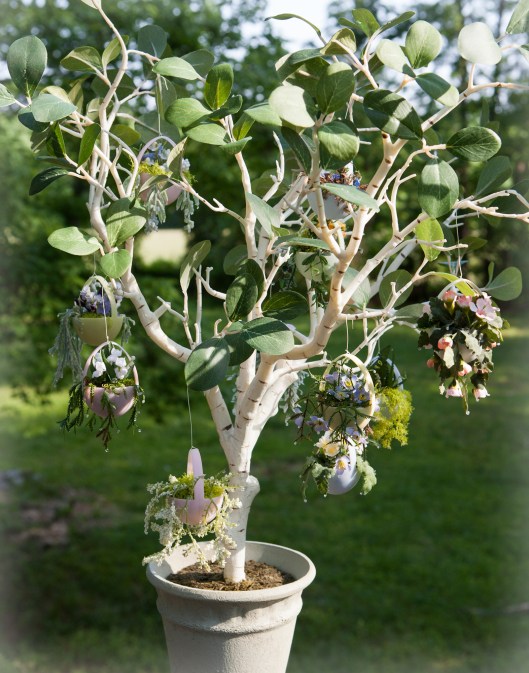
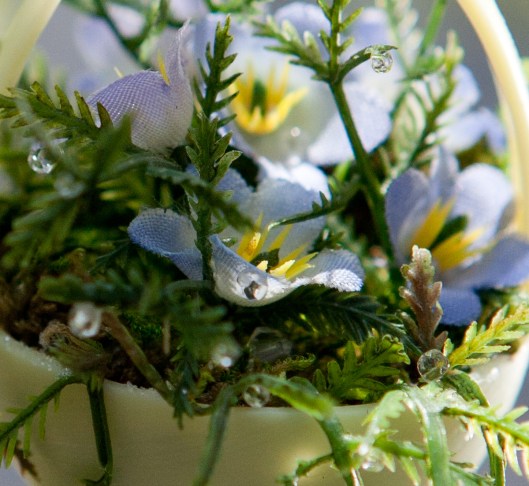
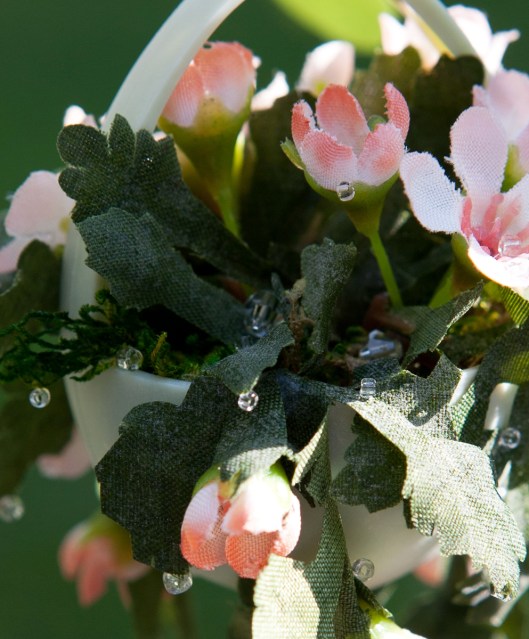
Last year I posted about the Hanging Plant Easter Egg Tree I made. It’s time to get it out again. Adding the drops of dew was my favorite part.
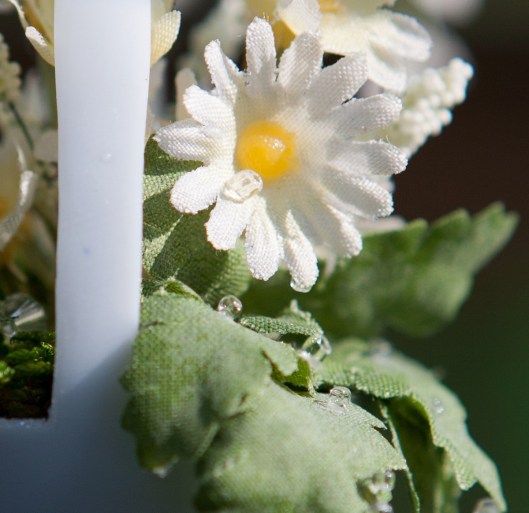
After I finished each miniature plant, with it’s tiny leaves and petals, I hung it on the tree. Though pretty, the plant didn’t seem fully alive it was all sparkled up with spring rain or drops of dew.
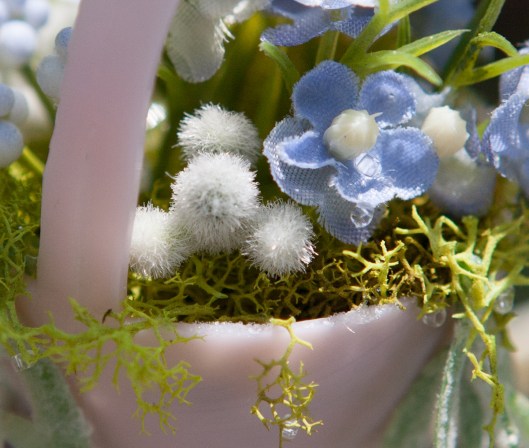
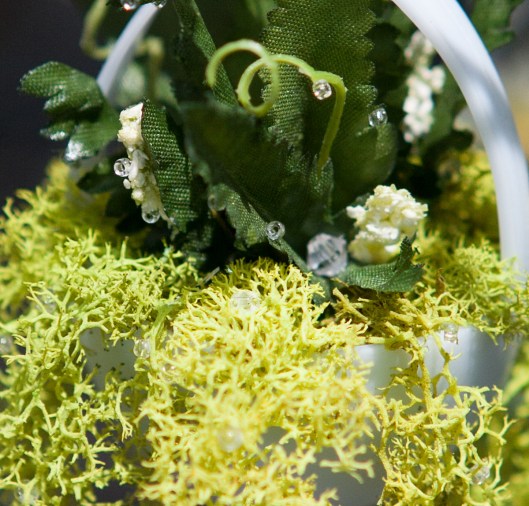
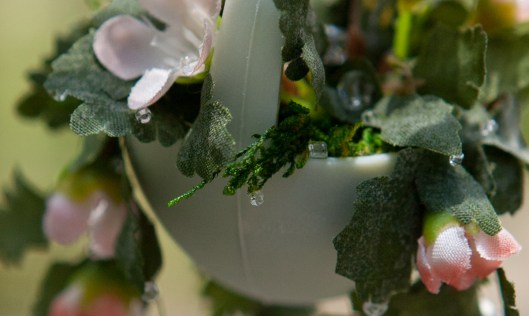
For each drop, I used tweezers to dab a single crystal seed bead in tacky glue and attach it where it should go, hanging from the tip of a leaf or puddled in the folds of a petal.

The tree was from Pottery Barn a couple years ago. The hanging egg baskets are cut from small plastic eggs and filled with tiny plants

The tree was from Pottery Barn a couple years ago. The hanging egg baskets were cut from small plastic eggs. The miniature plants were made by cutting up full-size artificial flowers and leaves. Some of the hanging vines were made by gluing hand-cut leaves to artificial plant stems. Click on photos to see the full size images if you wish.

2 Miniature Daisies

Miniature Daisies.

3 Miniature Daisies 2

Miniature daisies.

4 Miniature Lily of the Valley

Miniature Lily of the Valley.

5 Miniature Lily of the Valley 2

6 Miniature Fern

Miniature ferns and moss.

7 Miniature Forget me not 2

Miniature Forget-me-not.

8 Miniature Forget me not

9 Miniature Burros Tail

Miniature Burros Tail.

If you want to add realistic drops to an artificial plant, remember how real water acts. It flows down hill. So it will puddle at the bottom of a flower center, or hang from the lower tip of a petal or leaf.

10 Miniature Blue Flowers

Miniature Blue Flowers. The fluffy white balls were actually stamens cut from the center of a full-size artificial flower.

11 Miniature Ferns

Miniature ferns and moss.

12 Miniature Tuberous Begonia

Miniature Tuberous Begonia, reminiscent of the colors of my mom’s beautiful begonia hanging plant.

13 Miniature Peony

14 Miniature Peony 3

15 Miniature Marigolds

Miniature Marigold.

16 Miniature Rose

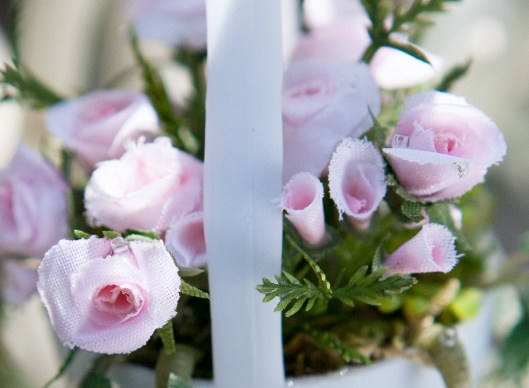
Miniature Roses. To make a rose, I took one petal from a 1″ artificial rose, folded it in half and glued and rolled it up into a cone shape. The pointed tip of the cone was cut off and stuck down inside the top part of the cone to make center of the rose. Some cone tips are also used as the buds.

17 Miniature Roses 2

18 Hanging Basket Egg Tree

Placing the tiny bead droplets on the plants was a very contemplative task, like yoga or painting, with each moment crystallized and beautiful. No it was not tedious, it was restorative and full of light. All sparkled up.
“And the Lord shall guide thee continually, and satisfy thy soul in drought, and make fat thy bones: and thou shalt be like a watered garden, and like a spring of water, whose waters fail not.” Isaiah 58:11

Share this:

  • Share on X (Opens in new window) X
  • Share on LinkedIn (Opens in new window) LinkedIn
  • Share on Facebook (Opens in new window) Facebook
  • Share on Pinterest (Opens in new window) Pinterest
  • Share on Reddit (Opens in new window) Reddit
  • Email a link to a friend (Opens in new window) Email
  • Print (Opens in new window) Print
  • Share on Tumblr (Opens in new window) Tumblr
Like Loading...

Time to put away the Valentines

28 Thursday Feb 2013

Posted by Julia Monroe in crafts, projects, tutorial, Valentine's Day

≈ Leave a comment

Tags

circuit board heart, circuit board Valentine, heart, scroll saw, Valentine, Valentine's Day

I am slowly collecting the most amazing valentines. I will be displaying these in a wood bowl on the coffee table next February. Next year, it might be a terra cotta Valentine…

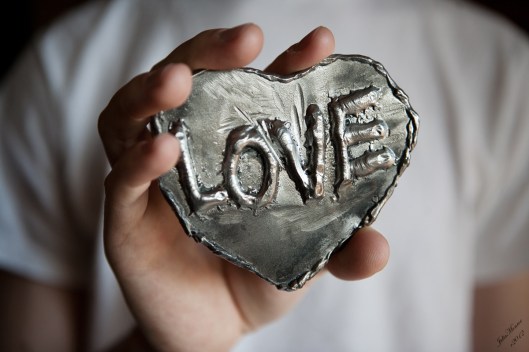
Last year, he made me a Welded Valentine of steel.

A Welded Valentine my son made for me

A Welded Valentine my son made for me


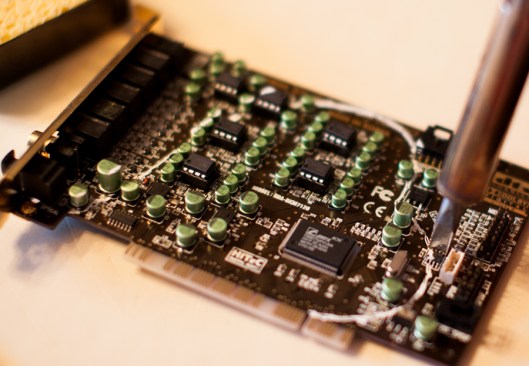
This year he worked with electronics.
Carefully unsoldering the resistors, capacitors and other components in the way of the cut line.

Carefully unsoldering the resistors, capacitors and other components in the way of the cut line.


He put on safety glasses and …
Carefully cutting on the white line with a scroll saw.

…Carefully cut on the white line with a scroll saw.


Then he gave me a Circuit Board Valentine!
Circuit Board Valentine

Circuit Board Valentine

Share this:

  • Share on X (Opens in new window) X
  • Share on LinkedIn (Opens in new window) LinkedIn
  • Share on Facebook (Opens in new window) Facebook
  • Share on Pinterest (Opens in new window) Pinterest
  • Share on Reddit (Opens in new window) Reddit
  • Email a link to a friend (Opens in new window) Email
  • Print (Opens in new window) Print
  • Share on Tumblr (Opens in new window) Tumblr
Like Loading...
← Older posts
Newer posts →

If you are a non-WordPress follower, enter your email address to follow this blog and receive notifications of new posts by email.

Tags

All Sparkled Up allsparkledup altered book art baking beach beads bird bread breakfast cake candy carving cat cats chocolate Christmas Christmas tree cookies craft crafts dessert DIY Easter Easter eggs eggs egg tree encouragement fabric family figs flowers food funny gardening Gilded Girls God granddaughter grandkids heart home decor hope inspiration inspirational jewelry jewelry making joconde light Little Plastic Bears miniature miniatures mixed media mousse nature painting PB & J pets photo photography projects recipe roses salad Scoliosis scripture sewing snow sparkling Spoonflower sunlight sunset Sunset Beach surgery tablescape tea tree tutorial Valentine's Day vintage book words

Archived Posts

Top Posts & Pages

Four Little Bunnies - a charming Easter tale from 1935
Meringue Breakfast Buns
Beaded Notebooks
Japanese Treats!
My kitten is growing
Marble window sills
Happy New Year 2014!
Ballerina Cake Pops!
Snowflake in the window
Finally a little snow

Recent Posts

  • Today I remembered something that used to sparkle…
  • Sfogliatelle
  • Blue Willow Toile
  • The Kitchen tea towel
  • The little cake she decorated
  • Icing flowers
  • Matthew 11:28
  • Christmas at Sea Tablescape
  • Gratitude
  • The Hot Air Balloon mobile has lights
  • Journaling in Coloring Books
  • The Light is still here.
  • A Hot Air Balloon decoration for my granddaughter’s room
  • Coco’s new favorite hangout
  • My kitten is growing

Post Categories

All Sparkled Up allsparkledup altered books American Girl Dolls art baking Baking for Neighbors ballet beach beading BFN birthday books cake decorating calligraphy candy cats Christmas color community cooking Craft Fail crafts DIY dolls drawing Easter encouragement Etsy fabric family fashion design Favorite Childhood Books flowers food Free Idea funny gardening Gilded Girls Gilded Life God granddaughter grandkids handmade books holiday home home decor Inspirational jewelry making journals lighting Little Plastic Bears Mexican miniature mixed media music nature New Years On my Worktable painting party pets photography Princess doll projects recipe Scoliosis Scripture sewing sketchbook sparkling Spoonflower sunlight sunset tea time Thanksgiving The cats time tools travel tutorial Uncategorized Valentine's Day water wedding woodwork words wreath
Follow All Sparkled Up on WordPress.com

Blog at WordPress.com.

Privacy & Cookies: This site uses cookies. By continuing to use this website, you agree to their use.
To find out more, including how to control cookies, see here: Cookie Policy
  • Subscribe Subscribed
    • All Sparkled Up
    • Join 287 other subscribers
    • Already have a WordPress.com account? Log in now.
    • All Sparkled Up
    • Subscribe Subscribed
    • Sign up
    • Log in
    • Report this content
    • View site in Reader
    • Manage subscriptions
    • Collapse this bar
 

Loading Comments...
 

    %d