• About

All Sparkled Up

~ Like dew hanging from the tip of a leaf, a single bead or word adds sparkle where there was none. BE the bright!

All Sparkled Up

Tag Archives: tutorial

The Crown Journal

15 Saturday Jun 2013

Posted by Julia Monroe in All Sparkled Up, crafts, Gilded Life, handmade books, journals, tutorial

≈ 5 Comments

Tags

All Sparkled Up, bookmaking, crafts, crown, handmade book, handmade journal, journals, lace, paper crafts, tutorial

The Crown Journal.

The Crown Journal.


For years I made my own blank journals using a standard codex construction with fabric bound spine and hardcovers. The signatures were sewn onto cords or tapes and then glued into the hard cover. This site, Humblebee & Me, has an excellent tutorial for sewing signatures on tapes.

It’s been a few years since I made a handmade journal so I finally had time to make one a couple months ago. I followed Jeanne Oliver’s video for stitching the signatures together from her wonderful The Journey of Letting Go class online . (I highly recommend the class, not just for the terrific art instruction, but also for the heart-felt inspirational videos. Jeanne, you’re the best!) Jeanne’s stitching process for sewing the pages together was easy and fun.

I didn’t photograph the steps to stitch the text block together but here is how I made the Crown Journal cover if you want to make one. This is an abbreviated tutorial but there’s enough here to give you basic instruction to make the lace crown, which would look great glued to an altered book cover. If you want actual measurements, let me know in the comments and I’ll measure some of the components for you.

It was fun going through my stash of supplies to pull out some pretty options.
The dyed seam binding tape, blue sequin fabric, lace and rhinestone chain were from A Gilded Life.
To make the text block, I cut up a sketch pad.
The linen was purchased from sources online.
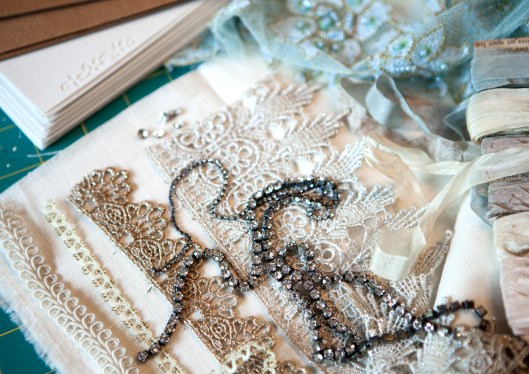
Glittery trims, lace and rhinestones to make a handmade journal.

Glittery trims, lace and rhinestones to make a handmade journal.

Both front and back covers were assembled the same way. Each cover has a piece of ivory linen and natural color linen, one small and one larger piece of chip board (cut from the back of a water color tablet) and a piece of thin cotton batting for padding under the ivory linen.

The materials used to make the book cover: Ivory linen over batting over chip board, which is then glued to a larger piece of chip board covered with natural linen.

The materials used to make the book cover: Ivory linen over batting over chip board, which is then glued to a larger piece of chip board covered with natural linen.

The batting is lightly glued to the small chip board square and then the ivory linen is placed over top of the batting. This piece is turned over and the ivory linen is glued to the back of the board, mitering the corners on the back.
The natural color linen is glued to the larger board without any batting.

Once the cover pieces are covered with linen, then you get to do the fun stuff!
I lay loose pieces of lace and rhinestone chain on the top of the book cover to see what I liked before gluing anything down.
I also tried several different lace pieces before making up my mind about the crown.
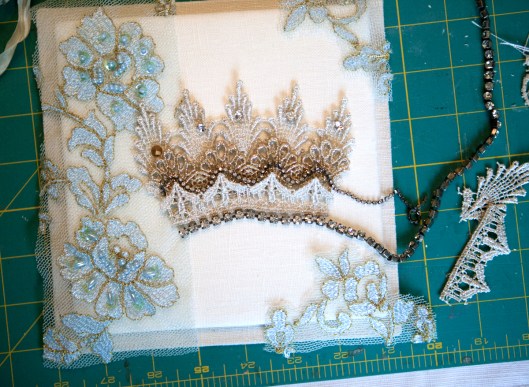
Trying out pieces of lace for the crown.

Trying out pieces of lace for the crown.

To glue such fine netting, I spread tacky glue on the flat lid of a plastic bin and then laid the blue lace in the glue… then quickly picked up the lace while still wet and smoothed it in position on the padded ivory linen.
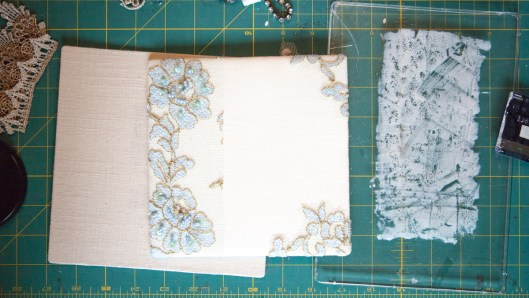
Gluing the sequined lace on the journal cover.

Gluing the sequined lace on the journal cover.

There was just enough glue on the thin lace netting to glue all the tiny pieces down securely, with no edges pulling up and no glue squishing up. I want the lace to be durable because this journal will last me at least a year.
Crown Journal-2c
The back of this board shows how the edges of the linen and lace are glued down on the back of the padded ivory board.
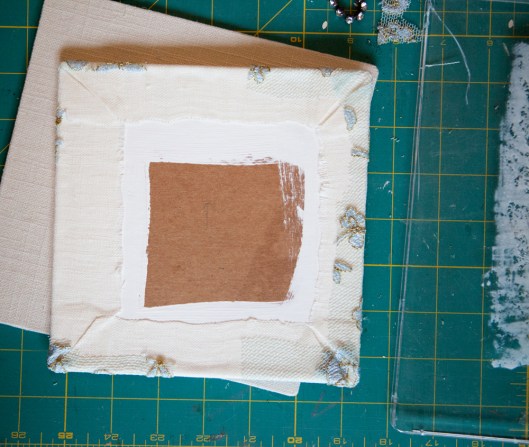
The back of the top cover piece.

The back of the top cover piece.

To make a lace crown, choose lace pieces that will look like the points of a crown when placed together. I used three different pieces of lace. To curve the lace, cut small slits between the motifs of the lace as shown.
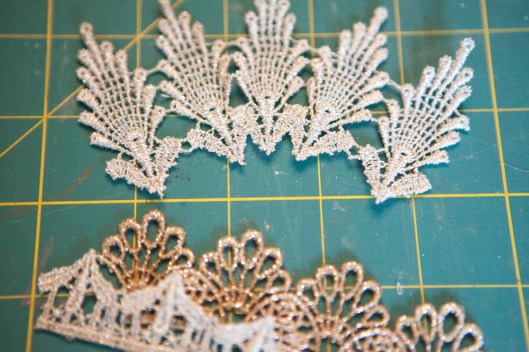
Crown Journal-3a Making the Lace Crown
Here you can see where I snip the lace so it will curve better.
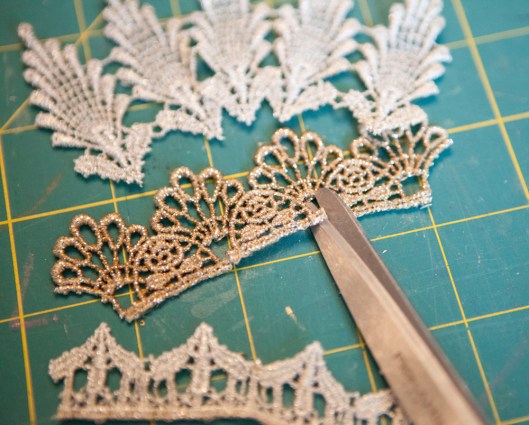
Snipping the lace so it curves better.

Snipping the lace so the edge can be overlapped so it curves better.

Once the lace is ready, glue the pieces together to form the crown.

The lace crown pieces all glued together.

The lace crown pieces all glued together.

Tacky glue is thinly spread on a smooth surface and the lace crown is carefully pressed into the glue.

The assembled crown is laid on wet tacky glue.

The assembled crown is laid on wet tacky glue.

While the glue is still wet, lift the lace crown piece up and carefully position it on the cover and press it down on the ivory linen. It dried fairly fast when I positioned it but I still pressed down in places to make sure it stuck well on all edges.

The crown is carefully positioned on the book cover and pressed down around all edges.

The crown is carefully positioned on the book cover and pressed down around all edges.

Cut rhinestone chain to size using jewelry cutters and glue it down with 527 Multi-Use glue or other strong jewelry glue.

Jewelry cutters are used to cut the rhinestone chain to size.

Jewelry cutters are used to cut the rhinestone chain to size.

I pressed my needle nose pliers into the book cover to make small indentations so rhinestones would set in deeper and more securely. These were glued with the 527 glue also.

If the gems are large, make a small indentation so they can be set more securely into the book cover.

If the gems are large, make small indentations so they can be set more securely into the book cover.

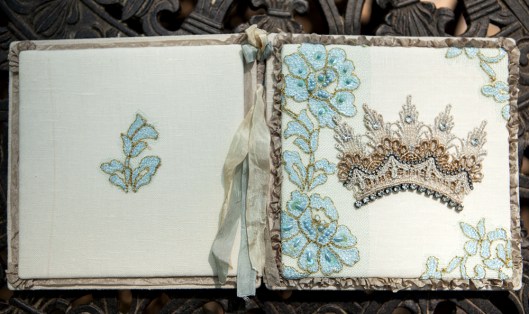
The crown is complete.
Crown Journal-4c
The front of the book cover is ready for the next step.
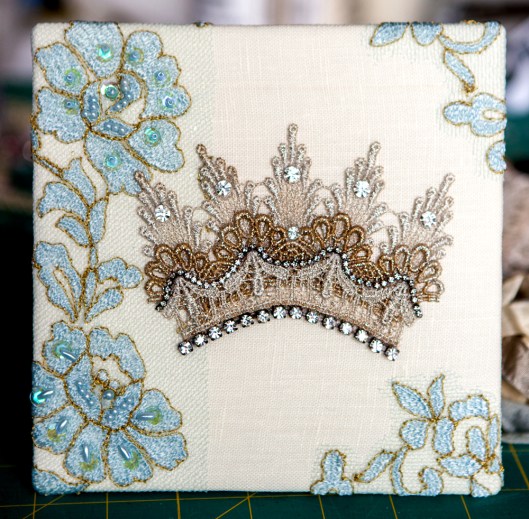
Crown Journal-4d
While the glue was drying, I made the ribbon rose buds for the journal spine. A length of ribbon was tied to make a loose knotted ribbon rose bud. I made three of these.
To make a knotted rose bud, the ribbon is tied as if about to make a knot, but the ribbon is looped over and over 4 times, not just once like a standard knot. Then when the ribbon is slowly pulled tighter, the layers of wrapped ribbon overlap and form a pretty bud shape. If the ribbon is pulled too tightly, the flower shape disappears and turns into a big knot. So you have to stop pulling while the ribbon is still loose. The ribbon “tails” are folded to the back and then stitched together so the ribbon bud doesn’t come apart. I cut off the excess ribbon and gently fringed the short ribbon tail under the bud.
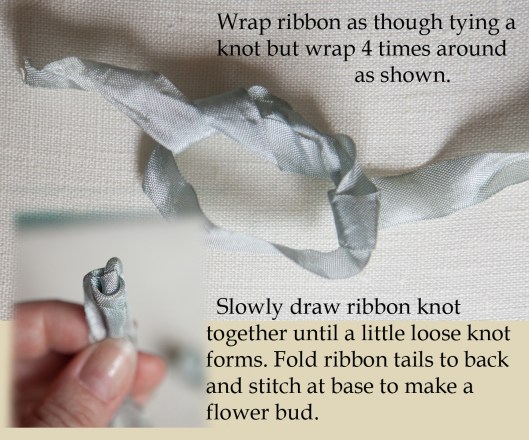
Making the ribbon rose buds.

Making the ribbon rose buds.

Three lengths of ribbon were stitched and gathered together.
Crown Journal-5b
These longer ribbons were stitched behind the flower buds.

The ribbon loops are sewn to the back of the ribbon rose buds.

The ribbon loops are sewn to the back of the ribbon rose buds.

I ruffled a long length of seam binding tape to use on the front cover. Here it is pinned down on the larger natural linen-covered board as I adjust the ruffles to fit. But before gluing down the ruffle, I glued on the decorative top of the cover.
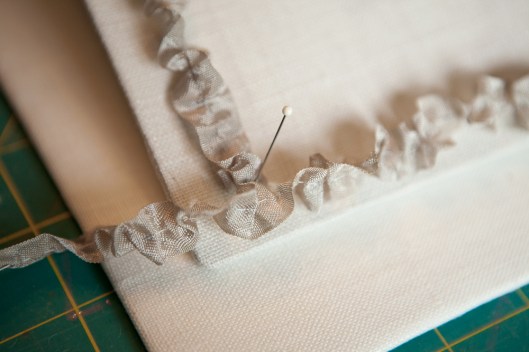
Seam binding tape is gathered down the middle and the pinned to the cover to check for size and adjust ruffles.

Seam binding tape is gathered down the middle and then pinned to the cover to check for size and adjust ruffles.

I spread tacky glue generously over the back of the ivory cover piece and pressed it down on the larger board.

Glue is squirted on the inside of the top cover piece. After taking this photo, I spread the clue around using an old credit card and made sure the glue extended all the way to the edges and corners.

Tacky glue is squirted on the inside of the top cover piece. After taking this photo, I spread the glue around using an old credit card and made sure the glue extended all the way to the edges and corners. Tacky glue is great because it sets up fast but you have to work quickly.

Some of the glue squished out around the edge but that was good. I used my fingers and a pallet knife to press the folded ruffle into the glue. I used the ruffle folded in half all the way down the length for extra fullness. It was easy to press the center of the ruffled seam binding tape into the glue and it held well. I squeezed more tacky glue into any spaces that didn’t have enough to hold the ruffle well.

The top of the cover is glued on the larger linen-covered board. Then while the glue is still wet, the ruffled seam binding tape is pushed into glue.

The top of the cover is glued on the larger linen-covered board. Then while the glue is still wet, the ruffled seam binding tape is pushed into wet glue between the two boards.

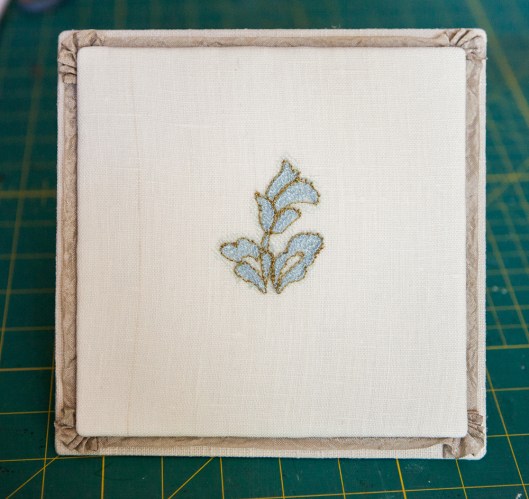
The back cover was different. Instead of a ruffle all the way around, I just pleated the four corners and let the seam binding tape stay flat on the sides. I glued this down before gluing on the back piece.
Crown Journal-7a
I cut a small motif from the blue lace and laid it in glue as for the front cover.
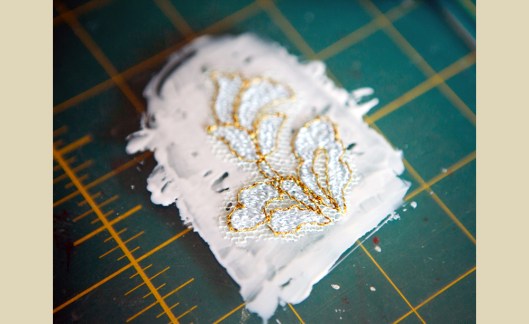
Crown Journal-7b
The glued motif was positioned and pressed down carefully, especially around the lace edges. Here is the finished back cover.
Crown Journal-7c
I glued a piece of decorative paper inside the front and back covers to cover the edges of the linen and lace. The same kind of paper was used to wrap the front and back signatures so they would match.
Crown Journal-8a
Each signature was folded inside a piece of vintage wallpaper or decorative paper. Here you can see the gap between two signatures in the journal.
Crown Journal-8b
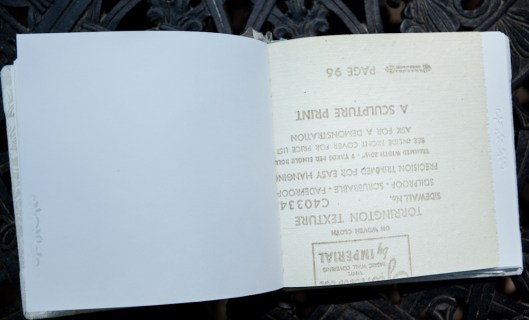
I accidentally placed this piece of wallpaper upside down during construction of the journal. I don’t mind because mistakes like this make me smile and remind me life isn’t perfect.
Crown Journal-8c
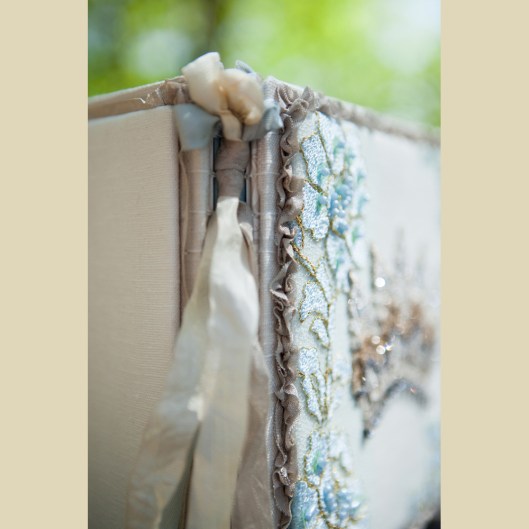
Once the book was sewn together, I stitched and glued the bundle of ribbon rose buds into the spine.
Crown Journal-9a
Crown Journal-9b
Here you can see the stitching along the spine.
Crown Journal-10
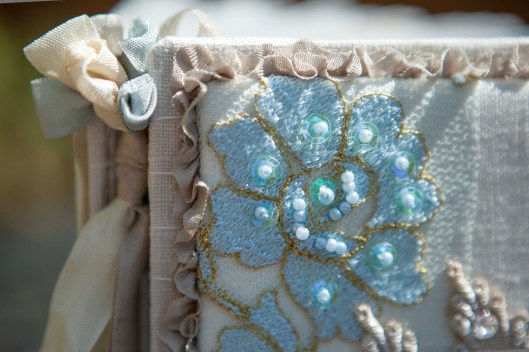
The bundle of rose buds in the spine doesn’t interfere with the book opening fully.
Crown Journal-11
I used a decorative paper punch to punch the edges of pages in random places.
Crown Journal-12
One of the ribbons is threaded in between two signatures to be used as a ribbon bookmark.

One of the ribbons at the spine is used as a bookmark.

One of the ribbons at the spine is used as a bookmark.

Crown Journal-15

The finished Crown Journal.

Crown Journal-14

The binding of this book allows it to open fully, even with a ribbon bundle glued and sewn into the spine.

This journal will last me about a year because I tend to write very small. I’ve been using it for two months so far and it has shown no signs of loosening and all the lace and gems are glued down tight, even when I slide the journal between books on a bookshelf.

I have to confess that this is the prettiest journal I’ve had in a long time. It’s quite heavy and the covers are soft and silky to hold. All the prettiness has had an unexpected impact on me. Each night, when I pick it up to write, I noticed that my writings have become more optimistic. I’m really glad about that because I have a couple old journals that are genuine but much too sad to reread. This is the perfect journal for this time in my life, a time of transition and full of good things, all sparkled up.
Share this:

  • Click to share on X (Opens in new window) X
  • Click to share on LinkedIn (Opens in new window) LinkedIn
  • Click to share on Facebook (Opens in new window) Facebook
  • Click to share on Pinterest (Opens in new window) Pinterest
  • Click to share on Reddit (Opens in new window) Reddit
  • Click to email a link to a friend (Opens in new window) Email
  • Click to print (Opens in new window) Print
  • Click to share on Tumblr (Opens in new window) Tumblr
Like Loading...

The Moss Rose Bracelet is finished

07 Friday Jun 2013

Posted by Julia Monroe in All Sparkled Up, beading, crafts, jewelry making, projects, sparkling, tea time, tutorial

≈ 4 Comments

Tags

beading, beads, crafts, flower beads, jewelry, jewelry making, Moss Rose, moss rose bracelet, tutorial, vintage beads

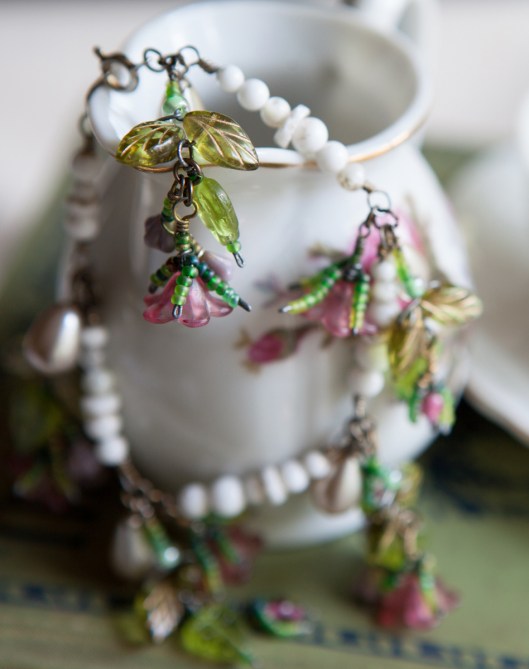
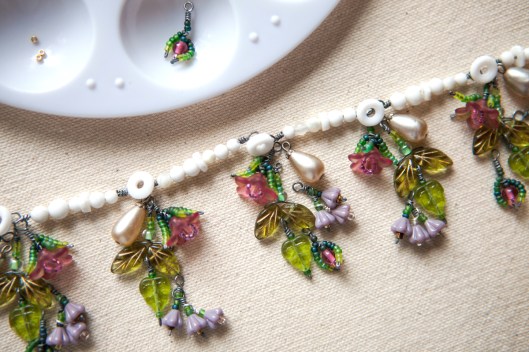
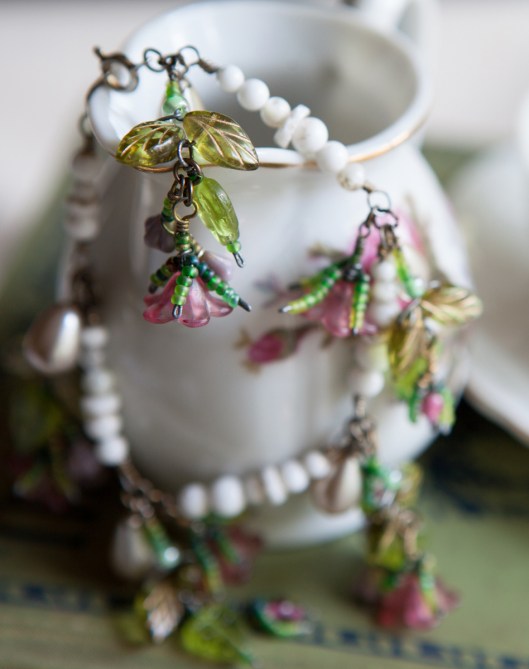
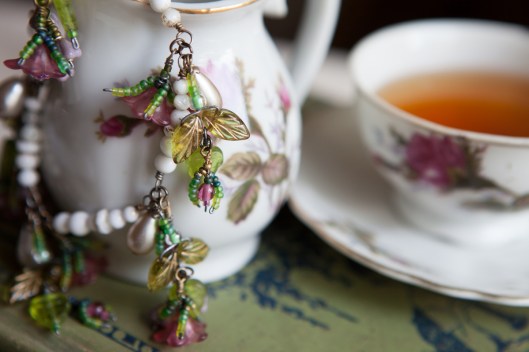
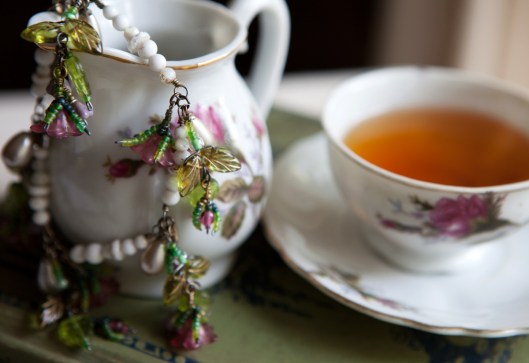
The Moss Rose Bracelet, inspired by an antique tea set from my Grandma, is finished and I love it! It turned out even better than I expected. ..happy smile…

Moss Rose Bracelet, inspired by a vintage teacup from my Grandma.

Moss Rose Bracelet, inspired by an antique tea set from my Grandma.

There are three things special about this bracelet. First, the colors truly say Moss Rose.
I was working from my stash of beads from French General, A Gilded Life and vintage beads and wasn’t sure I had all the right colors. Without intention, my love of Moss Rose must have influenced my purchase of beads over the years because I just happened to have the right colors. How cool is that! I had dark mossy greens, deep pinks and the perfect little dusty lavender cone flower beads. I was most particular about the white beads, which had to look like old white china. I didn’t have any rose beads but that was ok since all I really needed was the impression of a rose. I used Lucite trumpet flower beads with a bead calyx and that worked well.

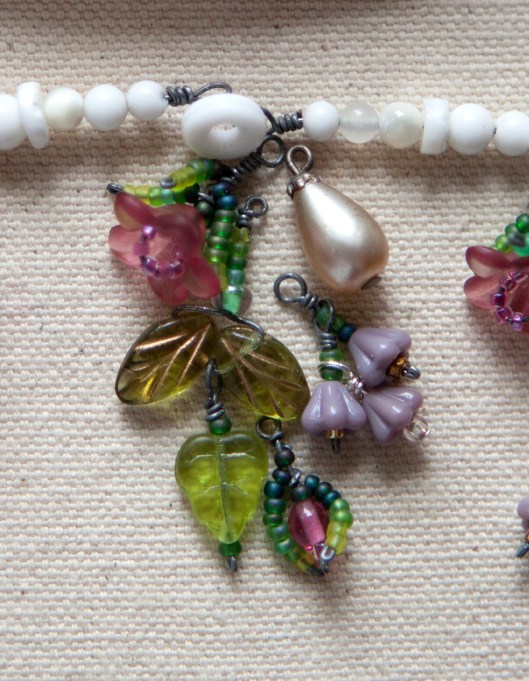
Moss Rose Bracelet components

Moss Rose Bracelet components

Second was the movement of the bracelet. Necklaces lay fairly still around the neck but bracelets have to move. They need shimmy and jingle, drape and sway, elegant like ballet. Bracelets need movement just distracting enough to be noticed. The Moss Rose Bracelet does exactly what I hoped it would do; the roses and leaves drip down and sway gently against my arm.

I love how loose and draping the leaves are on this bracelet.

I love how loose and draping the leaves are on this bracelet.

Third and best is how much the bracelet makes me think of my Grandma and my mom. Some of the beautiful china-white beads are from a broken necklace that belonged to my mom. So special. ♥

Even though I’m making a few of these bracelets to sell in my Etsy shop, I want to share how I made some of the components. I have not included directions for making the small clusters of purple flowers because some Moss Rose patterns do not have these flowers. But you can see how they were constructed by looking closely at the photos.

Make the “roses”
To make a rose, prepare the wires for the flower centers.
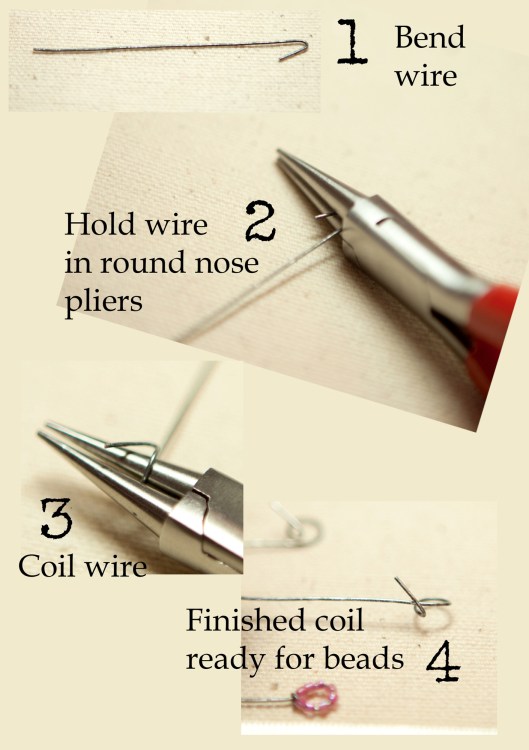
1. Bend 1/4″ at the end of a 2 1/2″ piece of jewelry wire.
2. Hold the bent part of the wire in round nose pliers.
3. Coil the wire using the round nose pliers. As the coil is formed, you will have to move the bent tail out of the way until a full coil is formed. It’s hard to explain but you’ll see what I mean as you bend the wire.
4. The finished coil, ready for seed beads.

Prepare the wires for the rose centers.

Prepare the wires for the rose centers.

Add about 8 seed beads to the wire.

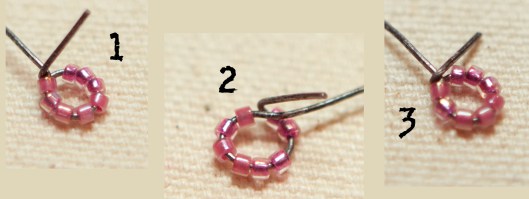
1. Slide the beads onto the wire and into the coil.
2. Make sure all the beads are in the coil and then bend the tail of the wire over.
3. Use needle nose pliers to fold the tail tightly around the wire as shown. Cut off the short tail close to the center wire using flush cutters.

Add beads to the flower center wire loop.

Secure seed beads to the flower center wire loop.

Shown here are all the steps to make a flower center.
Moss Rose Bracelet Tutorial 3

Prepare the beaded Calyx wires.
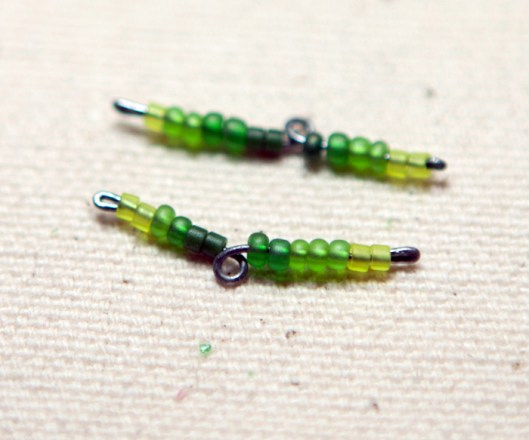
Start with a 1 1/4″ piece of wire.You can use head pins for this but I didn’t have enough so I made my own by tightly folding in 1/16″ of wire at the end. Two calyx wires are used for each rose and one for each rose bud. I varied the length of these to make the mossy roses and buds more realistic and natural looking. The color of green seed beads are placed in a light to dark to light pattern on each wire.
[NOTE: The photos show the way I made the wires first. But I had a few broken seed beads when I twisted the center of each calyx wire after the seed beads had been added. The better way would be to form the center loop first, then slide beads onto each side, and then fold the tip of the wire in to secure the beads. I don’t have photos of bending the wires that way but these photos will give you an idea of the finished product.]

Secure green seed beads on wires to use for the calyx.

Secure green seed beads on wires to use for the calyx.

The components to make a rose are two calyx wires, a trumpet bead flower and a round beaded wire center.

Components used in making a "rose".

Components used in making a “rose”.

Insert the flower center into a flower bead.  Slide the green beads apart at the center and bend the calyx wires in half.

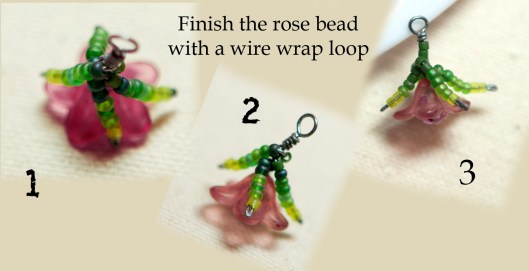
Insert the flower center into a flower bead. Using round nose pliers, bend the calyx wires in half and then bend until you have a tiny loop.

Two beaded wires ready to place on the flower wire.

Two beaded wires ready to place on the flower wire.

Moss Rose Bracelet Tutorial 8
Slide the calyx wires one at a time down over the flower. Twist a little tighter to make the calyx secure. That’s ok if they move a little. Remember, if you twist too tight, you might break some of the seed beads. It might be easier to make these directly on the flower wire so as to avoid any seed beads breaking. I will probably try that next time although this worked well enough.
Moss Rose Bracelet Tutorial 9

Moss Rose Bracelet Tutorial 10
I finished some of the flowers with just a wire wrapped loop. But others I added seed beads to make a slightly longer stem before finishing with a wire wrapped loop.

Make the rose buds
1. Make Calyxes as above, one per rose bud.
2. Slide a pink seed bead and then a 4 mm round pink bead on a 2″ wire with folded end or use a head pin. Then add a dark green seed bead. Slide the prepared beaded calyx wire over the round bead as you did for the flowers.
3. Add more seed beads to the wire and finish with a wire wrapped loop. I slightly spiraled the calyx wires around the 4mm bead.
Moss Rose Bracelet Tutorial 11

Make the rose leaf clusters
Oh my goodness, I got so excited the night I figured out how to wire these! I was shutting down for the night and was staring at my work table, not seeing the beads. I was actually praying for some family members in distress and not even thinking of beading. Then all of a sudden I figured out how to wire the leaves together so they would dangle the way I hoped. God is so cool to give us ideas when we least expect it.
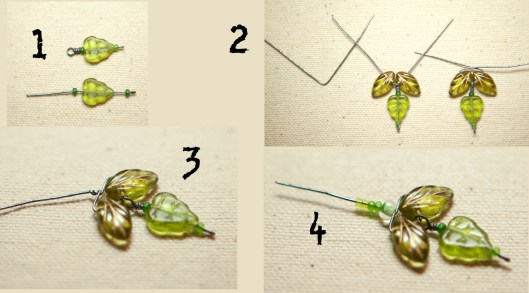
1. Prepare the center bead by sliding a seed bead, then a pressed glass leaf bead, then another seed bead on a 2″ wire with folded end or head pin. Finish with a wire-wrapped loop and set aside.
2. Cut a 3″ piece of wire and bend at a 90 degree angle as shown.
Slide the center bead you made down to the angle in the 3″ wire.
Slide a leaf bead on each side of the center bead.
Fold the wires toward the center of the two beads. The wires will cross over. Where the wires cross over, twist the wires together at the top, as in photo 3. Be careful you don’t twist too tight or you may shatter the leaf beads. I didn’t break any but I know that’s a possibility if you make the twist too tight.
3. Cut one of the wires with a flush cutter as shown so you have a single wire remaining. The twist should be tight so that it will fit inside a bead in the next step. Click on the photo and then click the number link at the upper left of the photo to view the original size image to see a close up of the construction.
4. Slide a larger bead with a hole big enough to cover the twisted wires. Add a couple more seed beads on the remaining wire. Finish with a wire wrapped loop.
Moss Rose Bracelet Tutorial 12

Gilding
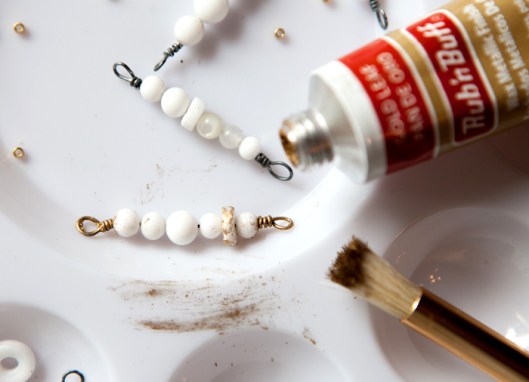
The Moss Rose tea set I have has a delicate border of gold, much of it worn off by age. I duplicated that touch of gold by using Rub n Buff and a stiff brush to add a touch of gold to the some of the white beads and wire findings on the bracelet components.
Moss Rose Bracelet Tutorial 13
Here are the beads all ready for assembly. I moved them around on the table a bit until I came up with a design I liked. I ended up not using the little white doughnut beads but it was fun to have options.

Moss Rose Bracelet Tutorial 14
The bracelet is finally assembled using jump rings to attach all the pieces together.
Moss Rose Bracelet Tutorial 15

Moss Rose Bracelet Tutorial 17

Moss Rose Bracelet Tutorial 18

Thank you for visiting my blog. I truly appreciate it! Blog readers get just little glimpses into our lives; they see splashes of color, tangles of wire, components lined up but not always connected. I really appreciate your faithfulness as I figure out how to make this blog better for you.

In the beginning of this blog, I didn’t have any readers at all but merrily posted away like a little bird chirping in a forest. Then I went through a rough time after breaking my back and getting major surgery, with its months of medicated pain management. Over the past year my posts weren’t always happy. But I have come to value life and the beautiful people in it more than ever.

This blog is for you. Like tending a garden of roses, I’ve done some weeding and deleting here. What is left are posts I hope have value, and the ones written when I did my best to be brave. I’m learning how important it is to stay true to the sparkling things in life and share the best. I guess we all grow in grace like that. I want to give you something good because your presence here reading my blog is a gift of pure grace. Thank you.

May grace adorn your life, with all the splendor you hoped for.
Love to you, my dear readers!

Share this:

  • Click to share on X (Opens in new window) X
  • Click to share on LinkedIn (Opens in new window) LinkedIn
  • Click to share on Facebook (Opens in new window) Facebook
  • Click to share on Pinterest (Opens in new window) Pinterest
  • Click to share on Reddit (Opens in new window) Reddit
  • Click to email a link to a friend (Opens in new window) Email
  • Click to print (Opens in new window) Print
  • Click to share on Tumblr (Opens in new window) Tumblr
Like Loading...

Teeny Tiny real Italian Dinner

13 Wednesday Feb 2013

Posted by Julia Monroe in baking, dolls, food, miniature, tutorial

≈ Leave a comment

Tags

Antipasto, Calzone, doll-size food, food, Italian dinner, miniature food, miniature real food, recipes, Spaghetti, Tiramisu, tutorial

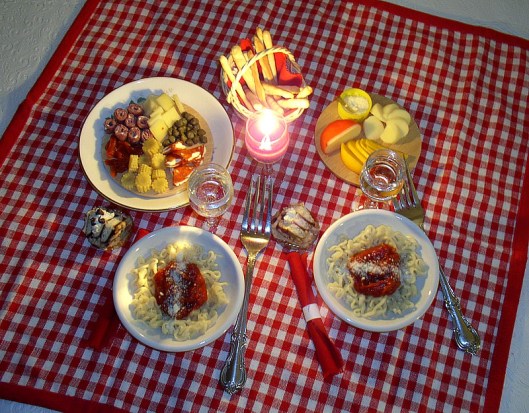
Just in time for Valentine’s Day, a romantic Teeny Tiny Italian Dinner. Perhaps for teeny tiny appetites. ;)
Back in 2004, I wrote a book for American Girl – Tiny Treats, published in 2006. The book included recipes for making tiny, edible, delicious doll-sized foods. Over 50% of the material got cut in the final editing. This is one of the chapters that didn’t make the cut, probably because it is quite ambitious. Please excuse my photography as these photos were not intended for publication. They were just a guide for the publisher and included with the original manuscript. I didn’t have a very good camera back then, nor did I have Photoshop. Also, the original was written for a child so I removed the “have an adult help you” lines in the directions.
Here you go…. Enjoy!

Teeny Tiny REAL Italian Dinner

BITTY BISTRO ITALIAN DINNER

MENU:

SPAGHETTI
CALZONE
ANTIPASTO tray of BABY CORN, STUFFED PEPPERONI TRIANGLES, OLIVES, TWO-TONE CHEESE, PASTRAMI PINWHEELS and ROASTED RED PEPPERS
CHEESE TRAY
SALAD
TOOTHPICK BREADSTICKS
TIRAMISU

SPAGHETTI

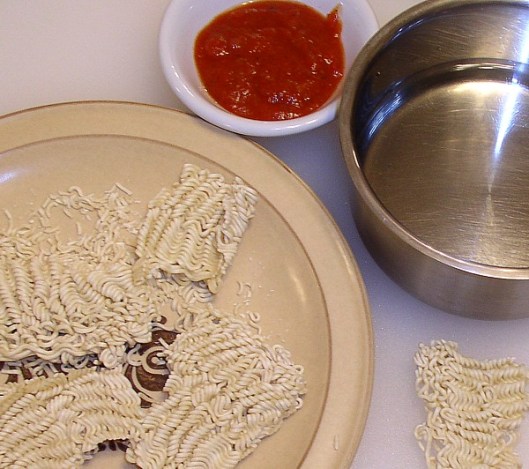
Tiny spaghetti

Tiny spaghetti

Ingredients:
Ramen Noodles
Spaghetti Sauce
Grated Parmesan Cheese
You also need:
Small pot

    1. Break up a package of Ramen noodles into 4 chunks. You only need one chunk so put the rest of the noodles in a plastic bag for some other time.
Break off a section of Ramen Noodles to use for the tiny spaghetti

Break off a section of Ramen Noodles to use for the tiny spaghetti

    2. Cook the piece of the Ramen noodles according to package directions but don’t add the seasoning packet. When the noodles are done cooking, remove from water with a slotted spoon and place on two serving plates.
    3. Top noodles with some Spaghetti Sauce and Grated Parmesan Cheese.

CALZONE

Bite Size Calzone

Bite Size Calzone

Ingredients:
Refrigerated French Loaf
Pepperoni slices, cut in half
1/4” squares of Montery Jack Cheese
You also need:
Clean scissors
Baking Sheet, greased or covered with Baking Parchment paper

    1. Preheat over to 350.
    2. Cut a 1/4” thick slice off the French Loaf bread dough with scissors. Pat the dough out to make a 1 1/2” circle.
Bite Size Calzone ingredients: cheese, refrigerator breadstick dough, pepperoni

Bite Size Calzone ingredients: cheese, refrigerator bread dough, pepperoni

    3. Place one piece of pepperoni and two squares of Monterey Jack Cheese in the center. Fold the circle in half and pinch the edge tightly shut. Place on the baking sheet.
Prepare the mini calzone using refrigerated bread dough.

Prepare the mini calzone using refrigerated bread dough.

    4. Bake for 14 minutes or till bottom is golden brown. Cool slightly before removing from baking sheet.

ANTIPASTO

NOT made of clay, this antipasto tray contains real, delicious ingredients.

NOT made of clay, this antipasto tray contains real, delicious ingredients.

Appetizer tray of: Baby Corn, Roasted Red Peppers, Pastrami Roll-Ups, Two-Tone Cheese, Mini Olives, Stuffed Pepperoni Triangles

Ingredients:
Baby Corn
Pimientos
3 Slices Pepperoni
1 Thin Slice Pastrami
Cream Cheese
Swiss Cheese
Provolone Cheese
Capers
You also need:
Dinner Knife
Clean Scissors
Wood or Cork Coaster for serving platter

Tiny Antipasto Tray ingredients

Tiny Antipasto Tray ingredients

    1. Cut baby corn into little slices.
    2. Stack the three pepperoni slices with cream cheese spread between. Cut with scissors into 6 triangles.
    3. Spread pastrami with cream cheese. Roll up. Cut into slices with scissors.
    4. Place Swiss Cheese on top of Provolone Cheese slice. Cut with scissors into little squares.
    5. Arrange all on a coaster.

CHEESE TRAY

Tiny Cheese Tray

Tiny Cheese Tray

Ingredients:
Various small Cheeses
Grated Parmesan Cheese
You also need:
Dinner Knife
Empty, clean bottle cap
One gold candy cup to make the cheese spoon (see further down this post for directions)
Wood or Cork Coaster for serving platter

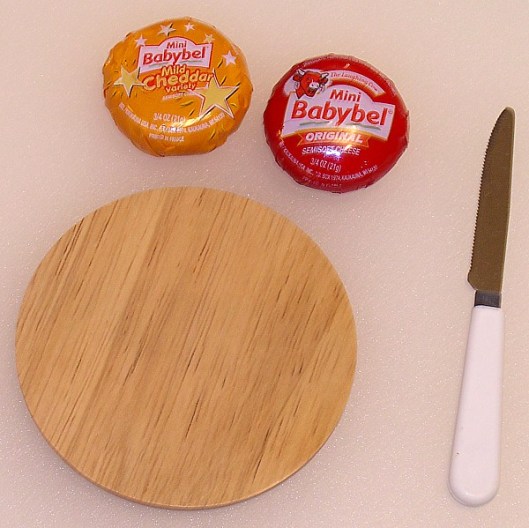
    1. Cut cheeses into small pieces and arrange on serving platter.
Cheeses for the tiny cheese tray

Cheeses for the tiny cheese tray

    2. Spoon some grated Parmesan Cheese into the bottle cap. 3. Make a small spoon for the Parmesan Cheese by cutting a tiny spoon shape from the gold candy cup.
SALAD

Tear up lettuce into tiny pieces. Cut grape or cherry tomatoes into tiny pieces

Tear up lettuce into tiny pieces. The green onion looks like full size onion slices and the capers look like olives.

Ingredients:
Lettuce
1 Green onion
Cherry or Grape tomatoes
Capers

    Tear up lettuce into tiny pieces. Cut any other salad ingredients you want into tiny pieces.

TOOTHPICK BREADSTICKS

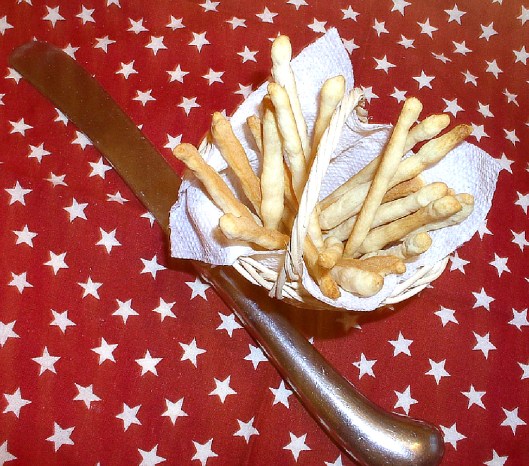
Tiny Toothpick Breadsticks

Tiny Toothpick Breadsticks

Ingredients:
Refrigerated Breadstick dough
Olive or Vegetable Oil
Salt
You also need:
Clean Scissors
Clean Brush
Baking Sheet

    1. Preheat the oven to 350.
    2. Unroll one Breadstick from the dough. Use scissors to cut the Breadstick into 4 pieces and roll each piece to make an 8” snake. Use scissors to cut the 8” piece into 4 pieces. Roll each piece as long as a toothpick.
Tiny Breadstick Ingredients - refrigerated bread dough and salt.

Tiny Breadstick Ingredients – refrigerated breadstick dough and salt.

10c Matchstick Breadsticks

Cut the dough into pieces and roll into tiny toothpick-size pieces.

Cut the dough into pieces and roll into tiny toothpick-size sticks.

    3. Brush lightly with oil and sprinkle with a pinch of salt.
Brush dough with a little olive oil and sprinkle with a tiny pinch of salt.

Brush dough with a little olive oil and sprinkle with a tiny pinch of salt.

    4. Place on a baking sheet and bake 6 to 9 minutes or until golden brown. Watch closely as they bake quickly!

TIRAMISU

This miniature Tiramisu is delicious!

This miniature Tiramisu is delicious!

Ingredients:
1 tablespoon Cream Cheese, softened
1 tablespoon Vanilla Ice Cream
1/8 teaspoon Instant Decaffeinated Coffee dissolved in 1/4 teaspoon Hot Water
3 Nilla Wafers
Chocolate Frosting
Whipped Cream
1/2 teaspoon Mini Chocolate Chips
You also need:
1/4 Measuring Cup lined with Plastic Wrap
Spoon

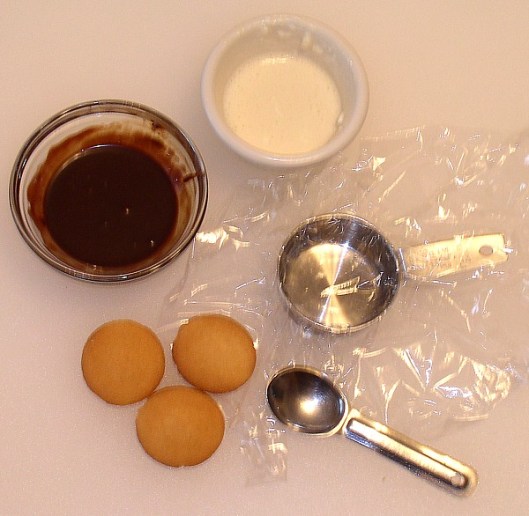
    1. Mix Cream Cheese with Vanilla Ice Cream and the dissolved coffee. The Ice Cream will melt and the mixture will look lumpy but that’s ok.
Ingredients used for the tiny Tiramisu

Ingredients used for the tiny Tiramisu

    2. Frost the Nilla Wafer cookies with Chocolate Frosting.
The ingredients for Tiramisu, ready for assembly

The ingredients for Tiramisu, ready for assembly

    3. Spoon a little Cream Cheese mixture into the measuring cup. Press a Nilla Wafer cookie down into the bottom of the measuring cup. Add some more Cream Cheese mixture and another cookie. Add more Cream Cheese mixture and the last cookie. Top with the rest of the Cream Cheese mixture. Let set about 20 minutes so the cookies can soak up the Cream Cheese mixture a little.
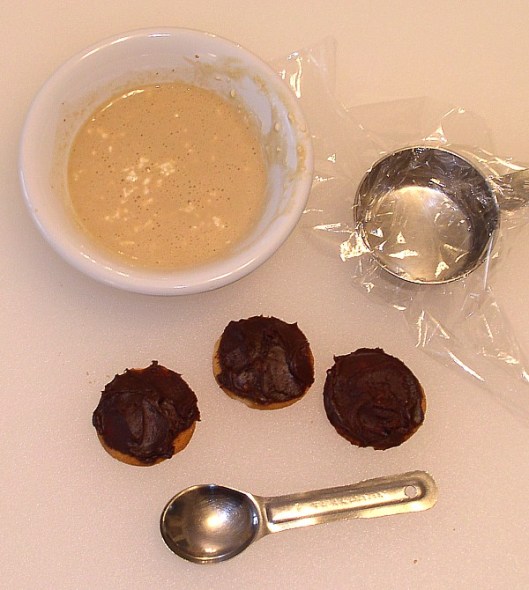
    4. Place in freezer for 2 hours or overnight. Take the Tiramisu out of the freezer and place it on a saucer. Remove the plastic wrap.
    5. To serve: Slice into 4 pieces and top each with a little Whipped Cream and Mini Chocolate Chips.
A tiny slice of Tiramisu

A tiny slice of Tiramisu

BITTY BISTRO CRAFTS

RED & WHITE TABLE CLOTH and NAPKINS

Tiny napkins and a red and white checked cloth napkin to use as a tablecloth

Tiny napkins and a red and white checked cloth napkin to use as a tablecloth

Use a red and white checked cloth napkin for a tablecloth.
Cut a red napkin or piece of red fabric into 4 inch squares.
Roll up the napkin and tape a small strip of white paper around it.
CANDLE
Place a white candle in a small jar at the center of the table.
TRAYS FOR ANTIPASTO AND CHEESES
Use clean, wood or cork coasters.
BASKET FOR BREADSTICKS
Line a small basket with a piece of fabric or paper napkin.
GOLD PLATES FOR TIRAMISU
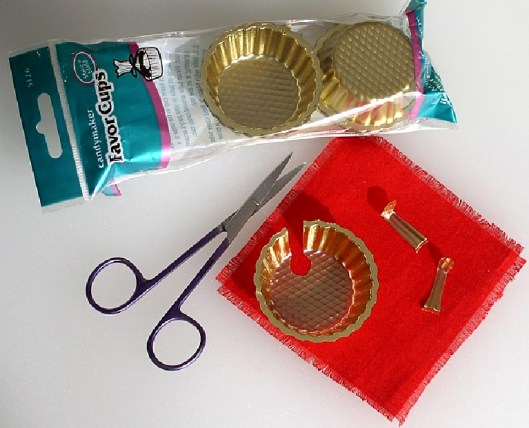
Cut most of the side off a small gold candy cup. The base of the candy cup makes a perfect dessert plate for creamy desserts.

Cut the rim off a plastic candy cup to use as a little dessert plate

Cut the rim off a plastic candy cup to use as a little dessert plate

TINY SPOON FOR GRATED CHEESE

Cut a spoon shape from the side and bottom of a gold candy cup

Cut a spoon shape from the side and bottom of a gold candy cup

Cut a tiny spoon shape from a small gold candy cup. The handle of the spoon is cut from the side of the candy cup. The bowl of the spoon is cut from the base of the candy cup.

Please leave a comment if you make this dinner. I would love to know what you think of it! We thoroughly enjoyed it. The only problem was there was too little of everything.

A miniature, Italian Dinner, REAL, totally edible and completely delicious.

A miniature, Italian Dinner, REAL, totally edible and completely delicious. Click photo to see the larger, original photograph.

Share this:

  • Click to share on X (Opens in new window) X
  • Click to share on LinkedIn (Opens in new window) LinkedIn
  • Click to share on Facebook (Opens in new window) Facebook
  • Click to share on Pinterest (Opens in new window) Pinterest
  • Click to share on Reddit (Opens in new window) Reddit
  • Click to email a link to a friend (Opens in new window) Email
  • Click to print (Opens in new window) Print
  • Click to share on Tumblr (Opens in new window) Tumblr
Like Loading...

Mirror Gem Notebook

30 Wednesday Jan 2013

Posted by Julia Monroe in All Sparkled Up, crafts, sparkling, tutorial

≈ 3 Comments

Tags

crafts, decorated notebook, gems, mirrors, mirrror, notebook, plastic gems, tutorial

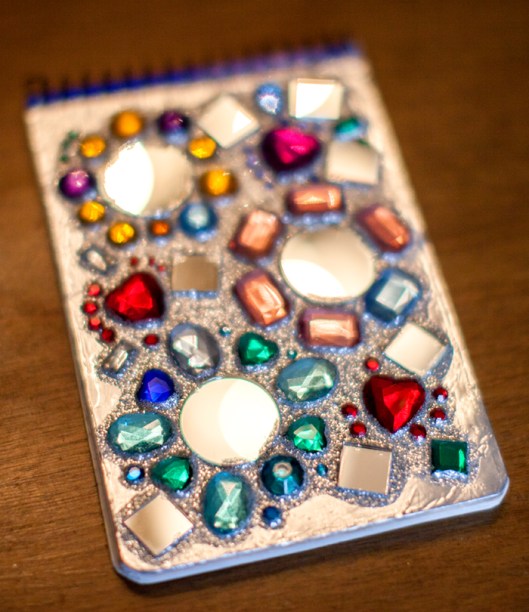
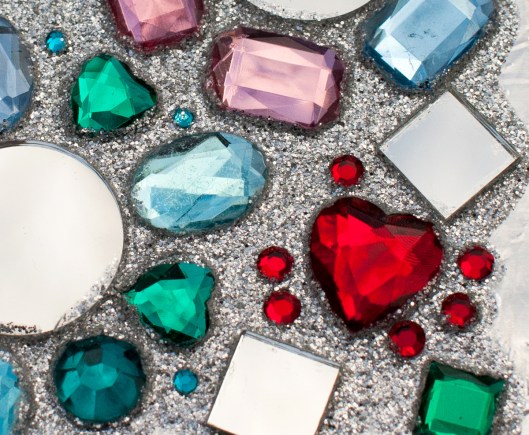
Today I reached for a notebook I haven’t used in years. I decorated this notebook in my hotel room during some free time during a writer’s convention. (Doesn’t everyone take glue, gems and tin foil to conventions for emergency crafting sessions?)

Mirror Gem Notebook

Mirror Gem Notebook

First I wrapped and glued a piece of tin foil over the front cover of a small memo pad.

Tin foil is glued on the cover of a memo pad.

Tin foil is glued on the cover of a memo pad.

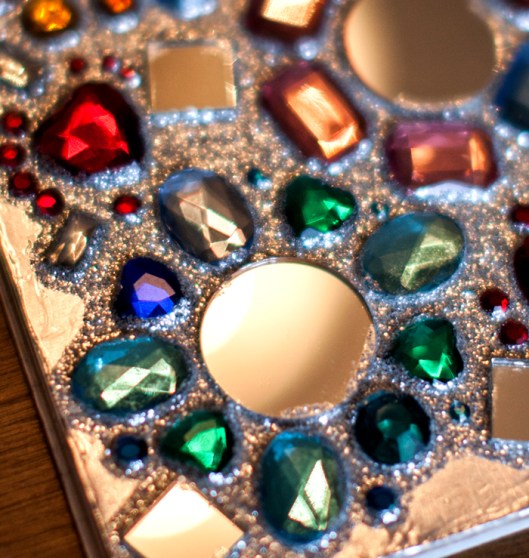
The gems and small craft mirrors were glued on with tacky glue and then secured around all the edges with silver glitter glue. I’m surprised that everything is still holding together over 8 years later.

Plastic gems and glass mirrors are glued on the notebook cover.

Plastic gems and glass mirrors are glued on the notebook cover.

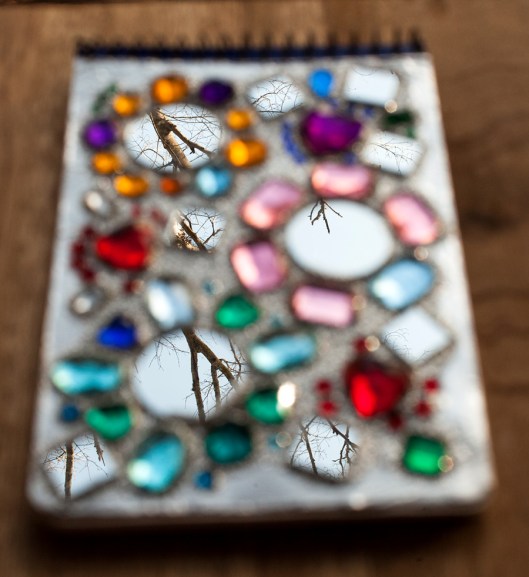
I love the gems on the cover of the notebook but there’s more to it than meets the eye. You just have to focus on something deeper than the glitzy cover.

Mirror Gem Notebook

Mirror Gem Notebook

Look past the outside.

Mirror Gem Notebook

Mirror Gem Notebook

Don’t get distracted by the gems.

Mirror Gem Notebook

Mirror Gem Notebook

Find the real sparkle.

Mirror Gem Notebook

Mirror Gem Notebook


Mirror Gem Notebook

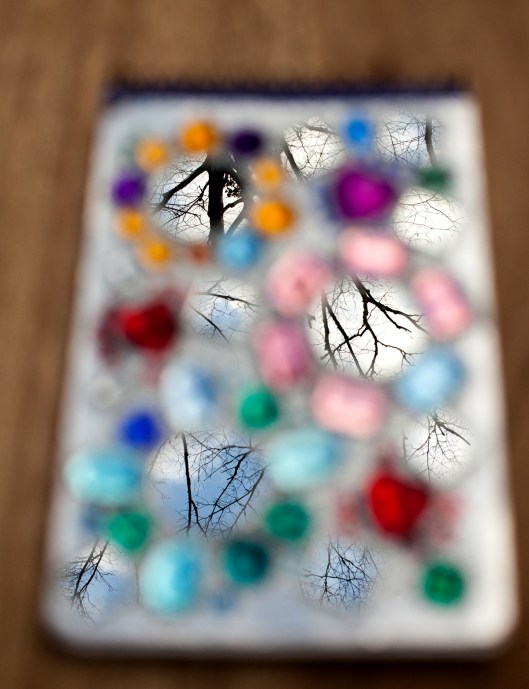
Appreciate what’s on the outside…

…just as much as what’s on the inside.

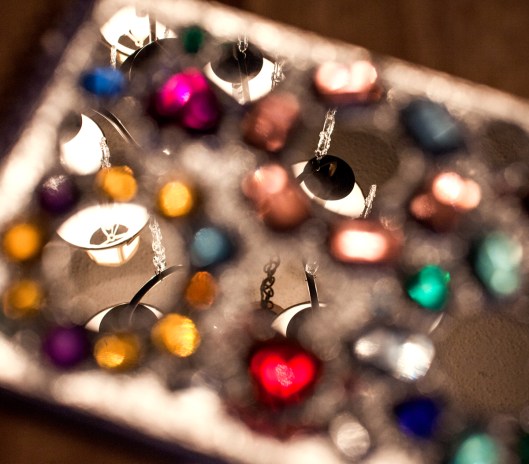
The dining room light is visible in the mirrors on the notebook cover.

Now the dining room light is visible in the mirrors on the notebook cover.

Trees in the cover of the Mirror Gem Notebook.

Enjoy the bigger picture – Trees in the cover of the Mirror Gem Notebook.

Share this:

  • Click to share on X (Opens in new window) X
  • Click to share on LinkedIn (Opens in new window) LinkedIn
  • Click to share on Facebook (Opens in new window) Facebook
  • Click to share on Pinterest (Opens in new window) Pinterest
  • Click to share on Reddit (Opens in new window) Reddit
  • Click to email a link to a friend (Opens in new window) Email
  • Click to print (Opens in new window) Print
  • Click to share on Tumblr (Opens in new window) Tumblr
Like Loading...

Printing on tissue paper for mixed media work

17 Tuesday Apr 2012

Posted by Julia Monroe in art, crafts, projects, tutorial

≈ 2 Comments

Tags

calligraphy, craft, map, maps, mixed media, printing, tissue paper, tutorial

I am making my first piece of mixed media art and wanted to use printed tissue paper in the background. I took quite a gamble using my new printer because any time you play around with something like this, it’s possible to void the warranty. Despite that risk, I did it anyway.

The design I used was from a class I took by Jeanne Oliver. She’s an amazing teacher and if you ever get a chance to take one of her classes, do it! When I get my piece done from her class I will post a photo of it.

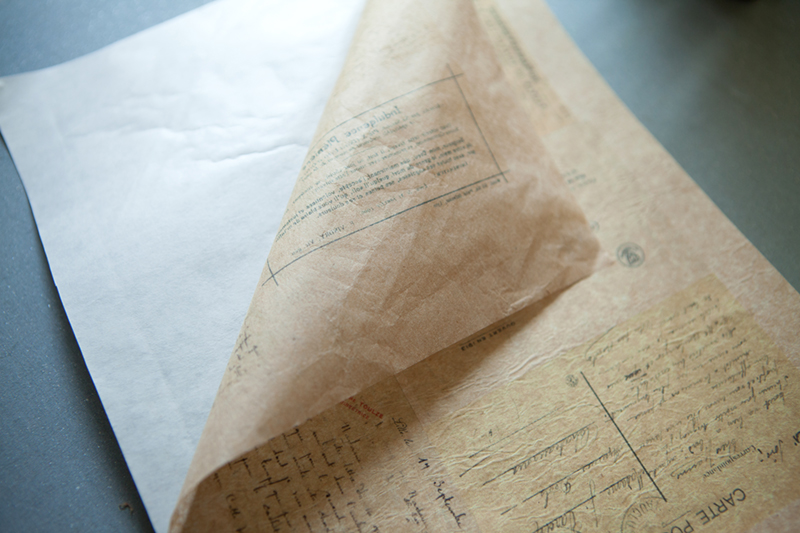
I ironed a sheet of tissue paper to a sheet of freezer paper, with the shiny plastic side of freezer paper against the tissue paper.
The paper was loaded as usual and printed with settings for a regular sheet of paper.
The printer didn’t jam, even while printing over the wrinkles.

Tissue paper ironed to a piece of freezer paper prints beautifully with the ink jet printer.

Tissue paper is carefully peeled off the freezer paper after printing.

The same piece of freezer paper can be used three or four times. I made the mistake the first time of thoroughly ironing the tissue to the freezer paper. It was impossible to remove the tissue after printing without tearing. I had to use the iron to melt the plastic holding the tissue to the freezer wrap.

If the tissue sticks too much, the tissue side is held carefully against the hot iron edge to melt the plastic that adheres the two pieces together. Tissue and freezer paper are peeled apart.

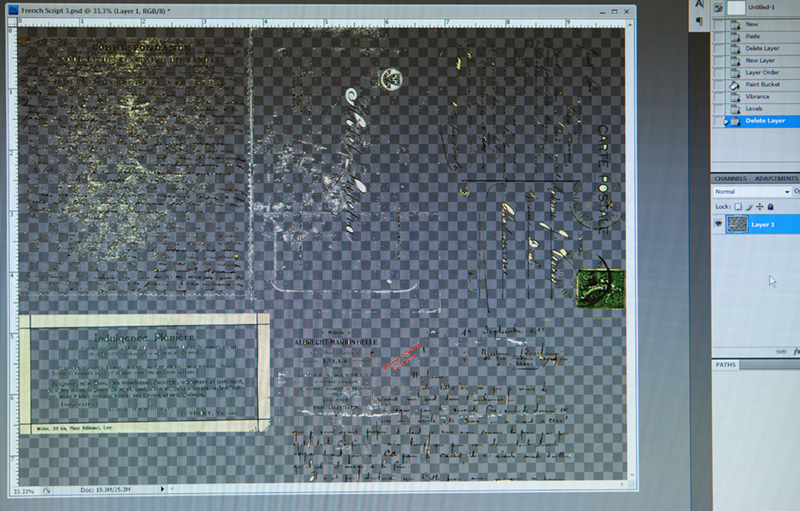
The first tissue print was a bit lighter than I wanted. I removed most of the background color of the file and increased the contrast in photoshop.

The sheet printed with isolated text layer in photoshop printed crisp and dark.

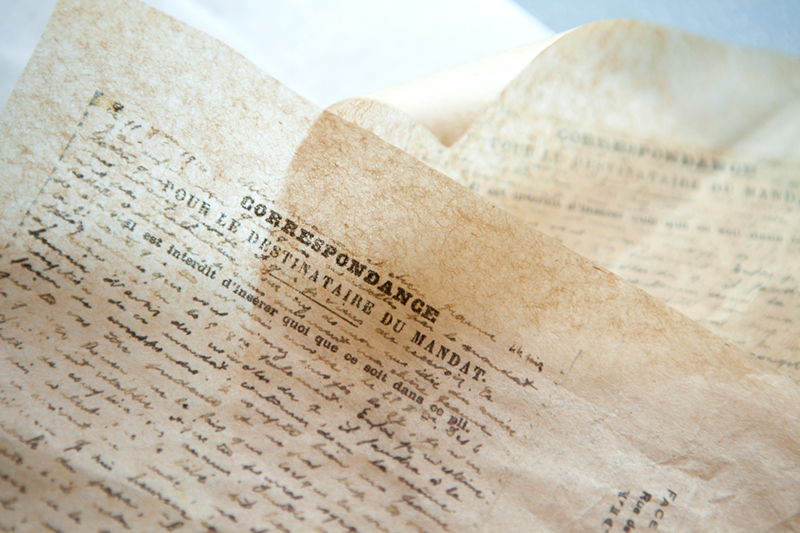
These maps printed on tissue paper are from scans taken from a 1935 World Atlas.

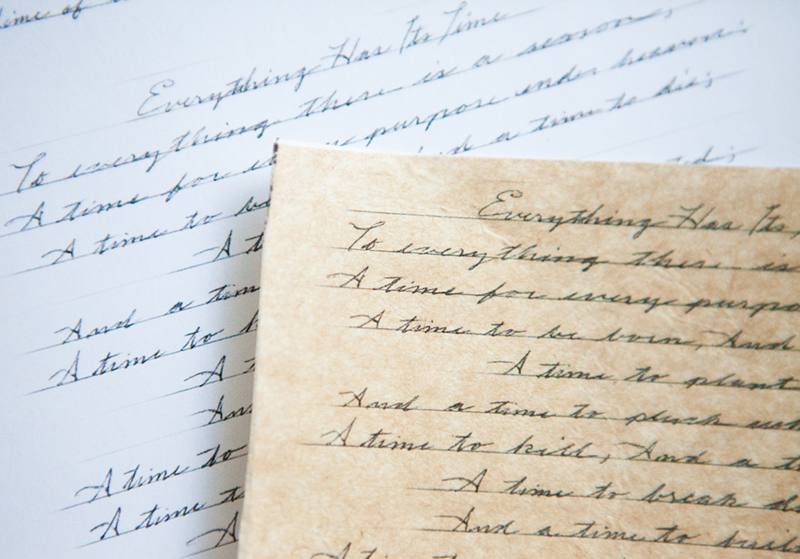
My favorite of all - my sister Donna's beautiful calligraphy of Ecclesiastes 3: 1-8

I’m using a Canon Pixma MX882 printer. The printed tissue paper stood up well when placed on a surface brushed with matte medium and then brushed over with more matte medium.

Share this:

  • Click to share on X (Opens in new window) X
  • Click to share on LinkedIn (Opens in new window) LinkedIn
  • Click to share on Facebook (Opens in new window) Facebook
  • Click to share on Pinterest (Opens in new window) Pinterest
  • Click to share on Reddit (Opens in new window) Reddit
  • Click to email a link to a friend (Opens in new window) Email
  • Click to print (Opens in new window) Print
  • Click to share on Tumblr (Opens in new window) Tumblr
Like Loading...

Creatively Made – Vintage Journal

22 Thursday Mar 2012

Posted by Julia Monroe in altered books, crafts, projects, tutorial

≈ 5 Comments

Tags

altered book, altered journal, book, projects, tutorial, vintage, vintage book

Weeks ago, I took a four week e-course called Creatively Made, taught by Jeanne Oliver. What an amazing class! I thank God for Jeanne and her wonderful way of encouraging people to be creative. Each week, participants were treated to at least a dozen videos filled with wise counsel, inspiration and instruction by Jeanne and her guest artists.

I took the course to learn how to use new materials and art technique but what started out as just an educational pursuit ended up life changing. I had no idea that I was missing such a big part of my life by not making time for art and creative pursuits. I will have to explain this life-changing event in another post. In the meantime, I am finishing up some of the projects inspired by that class.

One of the projects was a “Vintage Journal” made from the parts of a vintage book. Altered book projects are new to me. At first I couldn’t bear to tear apart a book. New or old made no difference; destroying any book seems a crime! But once I saw that there were dozens of old books available, some just gathering dust and rotting in used book stores, I didn’t worry as much about using a book for a purpose other than filling my already overflowing bookshelves.

This altered book is constructed different than the one taught in the class. I kept the spine intact and connected to the book covers. To add a text block in the book, I used ribbons to tie in the pages, 3-ring-binder style.

Vintage Journal - An altered book made from a vintage theology text in German.


My paternal Grandfather was a preacher of Pennsylvania Dutch and German heritage so this particular book is a lovely tribute to him. Alas, I can’t read German so I’m saving the pages and hoping to get some of them interpreted so I can incorporate them into the book.

Vintage Journal - The closure is a miniature metal keyhole plate. The doorknob is an old glass button from my Grandma's button tin. I'm always happy when I can include a little item that belonged to my Grandma.

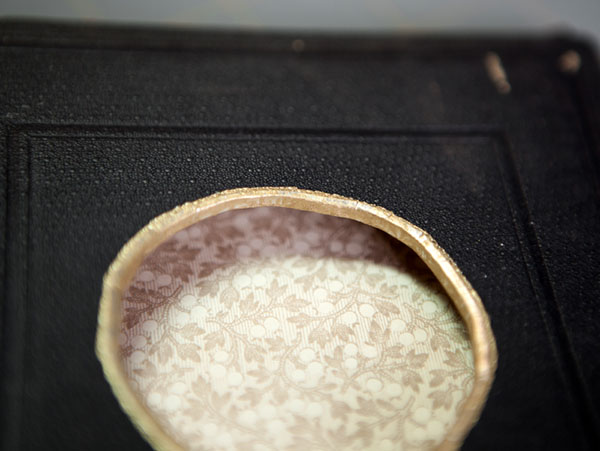
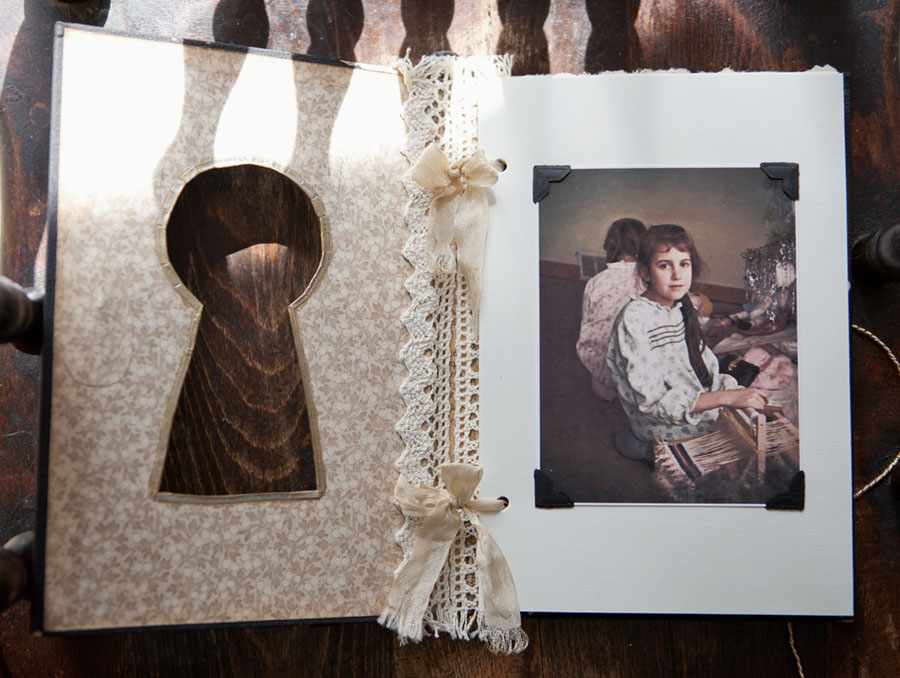
Vintage Journal 1 - Pages removed, keyhole shape window cut in the front cover.


The original book pages were stapled and glued into the spine so they were pulled out. I cut a keyhole-shape in the front cover. To finish the edge, I used 1/4″ silver foil tape and then painted it with gold acrylic paint.

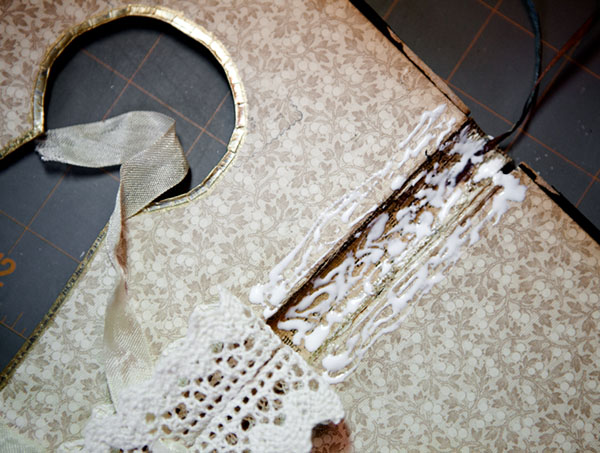
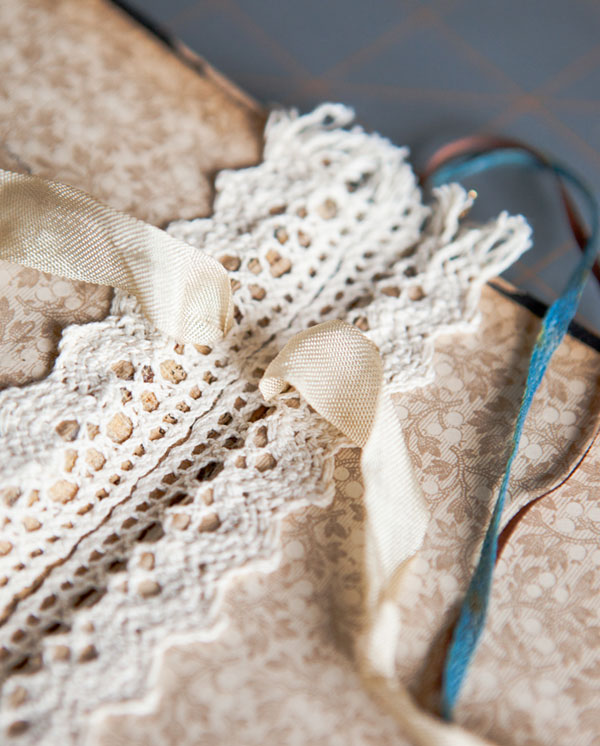
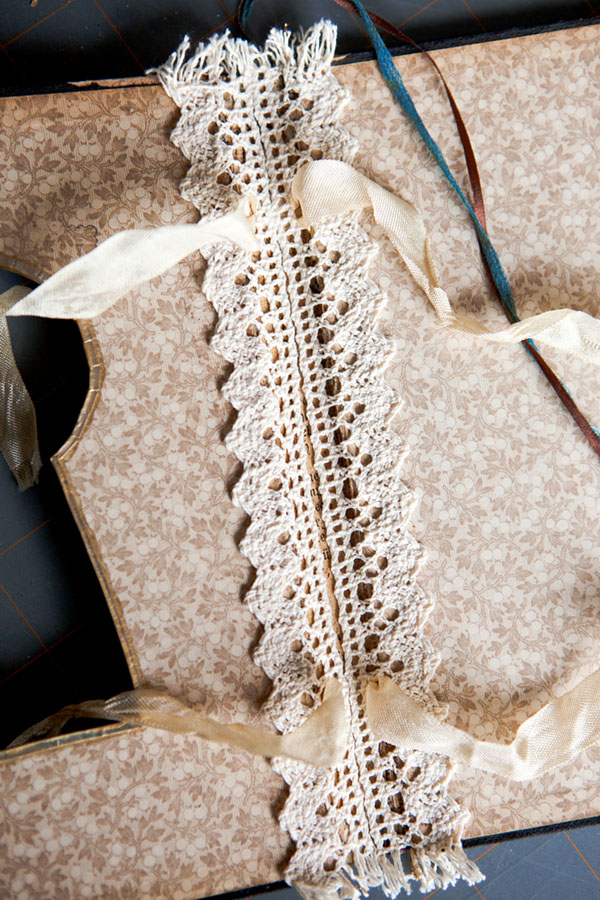
Vintage Journal 2 - Ribbon and lace glued inside the spine.


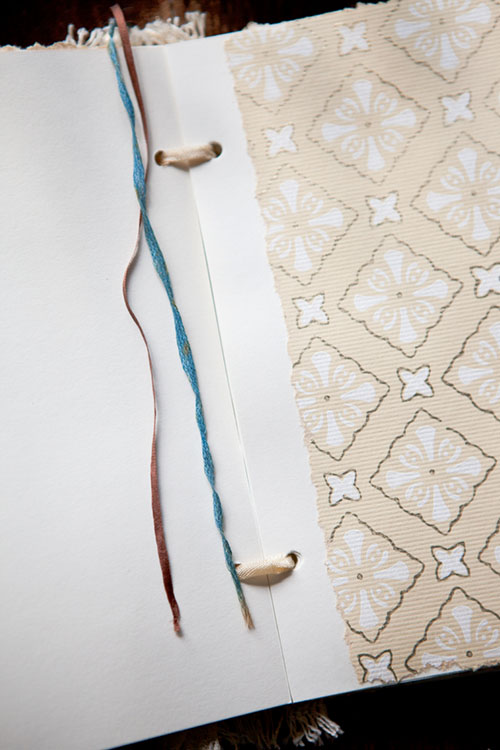
Inside the spine, I glued two strips of lace through which was threaded ribbon to tie in the pages. I also added a brown silk ribbon at the top to reinforce the thread-bare blue ribbon original to the book.

Vintage Journal 3 - Lace with ribbon glued inside the spine.

Vintage Journal 4 - The lace inside the spine reinforces the weak joint between the covers and the book spine.

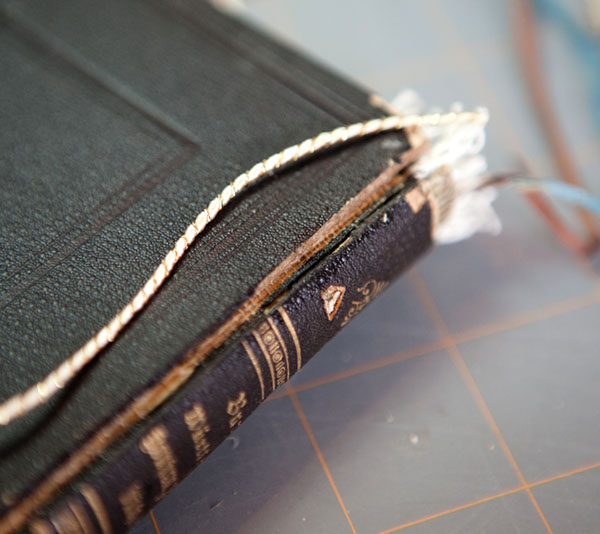
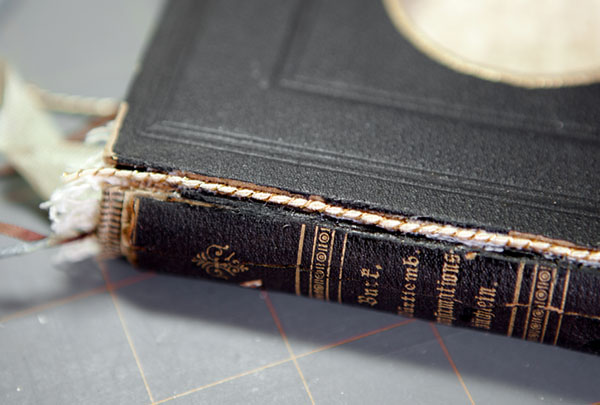
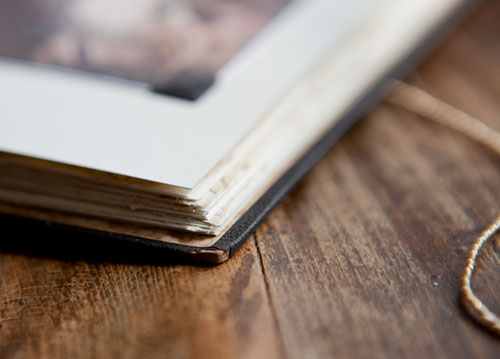
Vintage Journal 5 - There was a gap between the book covers and the spine.

Vintage Journal 6 - Thin gold-wrapped cord glued into the gap between the book covers and book spine.

Vintage Journal 8 - I cut pages of creamy sketchbook paper. I also used pages torn from a vintage wallpaper book but knew they could not withstand a hole punched joint. So they are glued to small strips of hole-punched sketchbook paper.

Vintage Journal 8 - I love the look of the deckle-edge wallpaper pages interspersed with the sketchbook pages.

Vintage Journal 9 - The bow must be tied close to the front cover, not the text block. This allows enough slack for the pages to slide along the ribbon and open fully.

Vintage Journal 10 - I have very few photos from my childhood so I cherish this one from Christmas Day, 1967. Alas, my little sister Donna is turned away from the camera. I love that she is there, even if I can't see her sweet face.

I am very happy with how this turned out. It looks as old as I wanted it to. The book was published in 1884 and I wanted to preserve the stark elegance of it but still make it mine. I’m looking forward to adding small sketches, paintings and writings to the pages.

Share this:

  • Click to share on X (Opens in new window) X
  • Click to share on LinkedIn (Opens in new window) LinkedIn
  • Click to share on Facebook (Opens in new window) Facebook
  • Click to share on Pinterest (Opens in new window) Pinterest
  • Click to share on Reddit (Opens in new window) Reddit
  • Click to email a link to a friend (Opens in new window) Email
  • Click to print (Opens in new window) Print
  • Click to share on Tumblr (Opens in new window) Tumblr
Like Loading...

Valentine Candy Bouquet

21 Tuesday Feb 2012

Posted by Julia Monroe in candy, crafts, food, party, projects, tutorial, Valentine's Day

≈ 8 Comments

Tags

bouquet, candy, candy bouquet, centerpiece, crafts, project, styrofoam ball, sweet, table decor, tutorial, valentine candy bouquet, Valentine's Day

We are still nibbling at the Valentine Candy Bouquet. It is delicious but very, very sweet. At this rate, it may hang on till Easter! Oh my! I do love the sparkling look of it though.

Valentine Candy Bouquet – 2012

Granddaughter Chloe nibbles a cake pop from the Valentine Candy Bouquet.

Here are directions on making the bouquet.

Prepare basket.

1. Cut Styrofoam to fit tightly in the bottom of a basket. Secure it firmly in the  basket so it won’t shift or move at all.

Secure Styrofoam in the bottom of a basket.

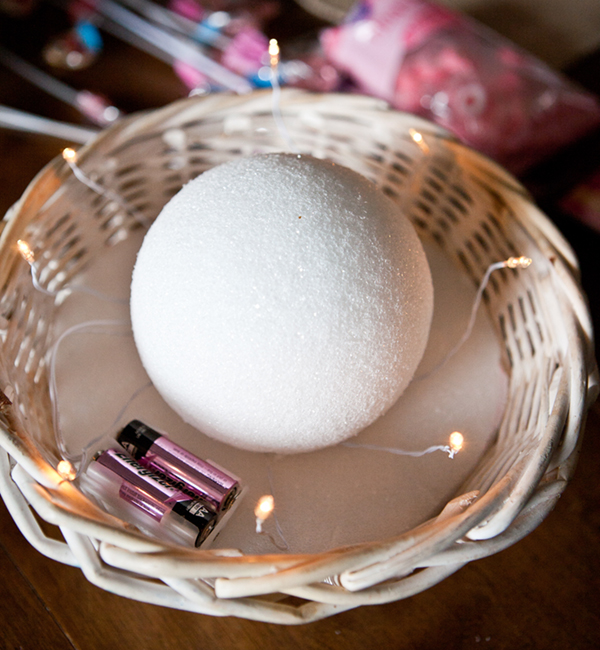
2. Spread out a set of battery operated bouquet or centerpiece lights over the Styrofoam in the basket. I purchased this light set at either Michael’s or A.C.Moore several years ago. Alas, I do not know if these lights are still made or sold elsewhere. Insert toothpicks around the light set in the area where the ball will be placed.

Spread light set around the edge of the basket.

3. Cut off a slice of a 5” Styrofoam ball so it can sit flat. Press the Styrofoam ball down firmly onto the toothpicks. Insert several other toothpicks around the base of the ball to secure it tightly. Trim toothpick ends with wire cutters.

Press the Styrofoam ball firmly down on the toothpicks

4. Scrunch a length of 12” wide tulle around the base of the ball, covering the lights and wires. I used a piece 12″ by about 6 feet long.

Prepare the candy.

5. To make Conversation Heart Batons, use royal icing to secure conversation hearts to a lollipop stick. When dry, pipe royal icing between the hearts and sprinkle with mini sprinkles. Tie a bow at the base with an 8” piece of ribbon; trim the ends.

Conversation Heart Batons

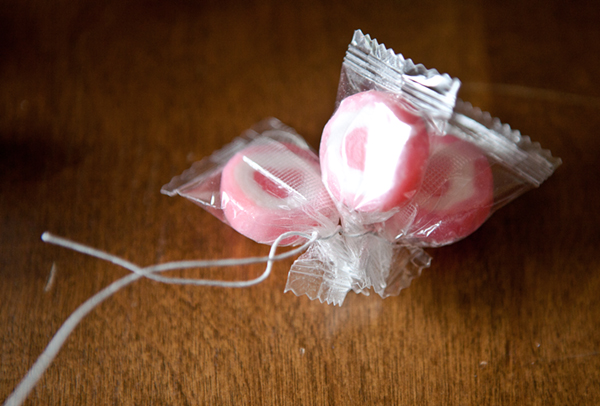
6a. For candies with square wrappers, twist one end of wrappers and wire three candies together.

Wire together three small candies

6b. Twist the candy bundle together around the end of a lollipop stick and secure with the wire. Tie with an 8” length of ribbon.

Wire the candy bundle around a lollipop stick & tie with ribbon

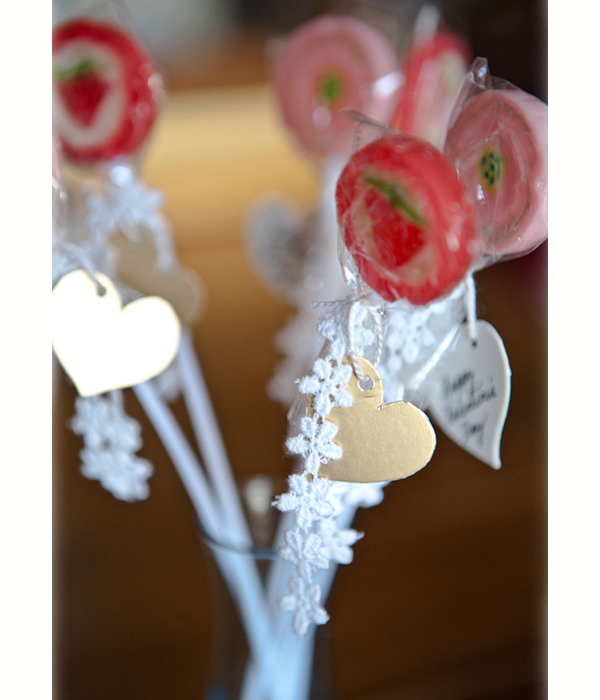
7. Cut a heart from gold paper, punch a small hole at the top and write a message. Tie a piece of lace and the gold heart to a lollipop with string.

Tie lace and a message with string to a lollipop.

8. Prepare cake pops as desired. I made chocolate cake pops by following the directions in Bakerella’s Cake Pops cookbook and using homemade frosting instead of store-bought frosting. These were the first cake pops I’ve ever made so mine were a little lumpy. But I was really happy they turned out and they are delicious!

Round cake pops.

9. Cake Pop secret – use lots of sprinkles to cover up mistakes.

Cone-shaped cake pops.

10. To help disguise the printed text at the base of lollipop wrappers, cut a fringe in the wrapper. Tie with a bow or twist tie.

Fringe bottom of lollipop wrapper and then tie with ribbon or twist tie.

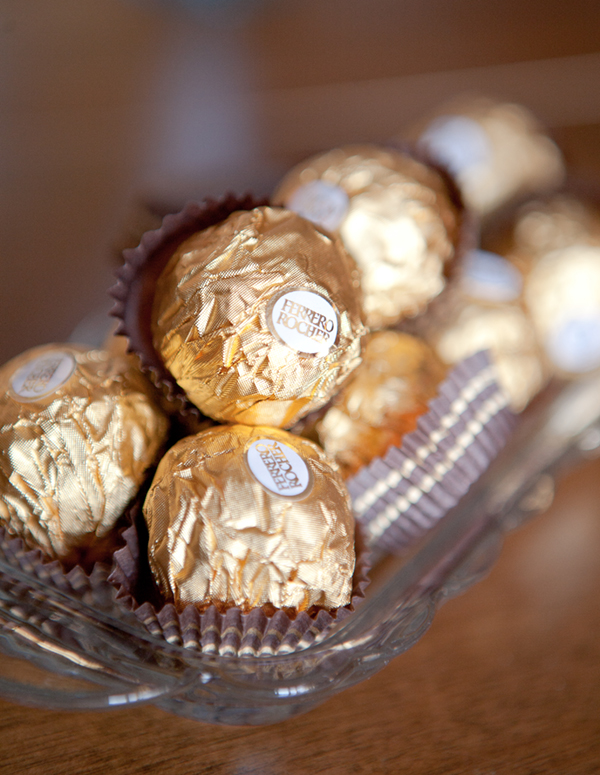
11. I ended up not adding these to the bouquet. They looked very pretty in a glass dish next to the bouquet.

A dish of gold-wrapped Ferrero Rocher chocolates.

Assemble the centerpiece.

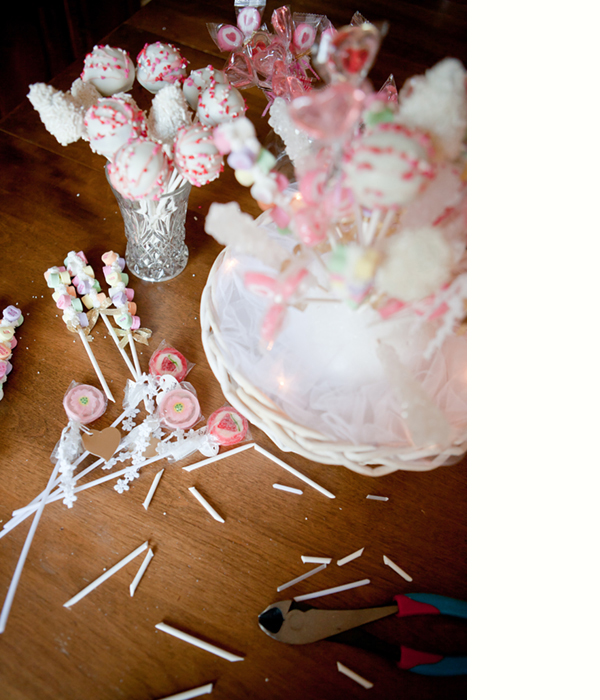
12. Using wire cutters, cut the end of one candy stick to make a slight point and insert it into the Styrofoam ball to see if you like the length. Remove the stick from the Styrofoam and adjust the length as desired. Cut sticks and insert candies, starting with the candy of which you have the fewest. I only had 8 sticks of rock candy so I inserted them first to evenly distribute them.

Cut sticks shorter with wire cutters and insert into Styrofoam ball.

13. Start in the center and work your way out as you fill the bouquet. Cut some sticks shorter so the candies help cover the Styrofoam ball. Next time I will make more of the little candy bundles to fill in the base better. I made 11 but 14 would have been better.

Valentine Candy Centerpiece

14. If desired, fill in any remaining spots on the Styrofoam ball with ribbon or tulle bows on wires. You can also use green gumdrop leaves, tissue paper or artificial flowers and leaves. I decided to leave the center open so the light set would light up the candy more.

To make ahead, the cake balls can be prepared a day or two ahead, as recommended in Bakerella’s cookbook. This bouquet was made on Valentine’s Day and then refrigerated that night, covered with plastic wrap for storage. It is one week later and the bouquet still looks wonderful and the cake pops are every bit as delicious, especially cold. Next year, I’ll prepare the cake pops several days before, refrigerating them until needed. The candies can be prepared well in advance and set aside. Allow an hour or so to insert all the prepared candies and cake pops.

In addition to holidays, a Candy Bouquet would look lovely for a Baby or Bridal shower, or as a Birthday centerpiece.

Valentine Candy Bouquet – click for a larger image.

Share this:

  • Click to share on X (Opens in new window) X
  • Click to share on LinkedIn (Opens in new window) LinkedIn
  • Click to share on Facebook (Opens in new window) Facebook
  • Click to share on Pinterest (Opens in new window) Pinterest
  • Click to share on Reddit (Opens in new window) Reddit
  • Click to email a link to a friend (Opens in new window) Email
  • Click to print (Opens in new window) Print
  • Click to share on Tumblr (Opens in new window) Tumblr
Like Loading...

Miniature Birthday Fiesta

07 Saturday Jan 2012

Posted by Julia Monroe in crafts, miniature, party, tutorial

≈ 2 Comments

Tags

American Girl dolls, crafts, doll-size, fiesta, miniature, miniature pinata, tutorial

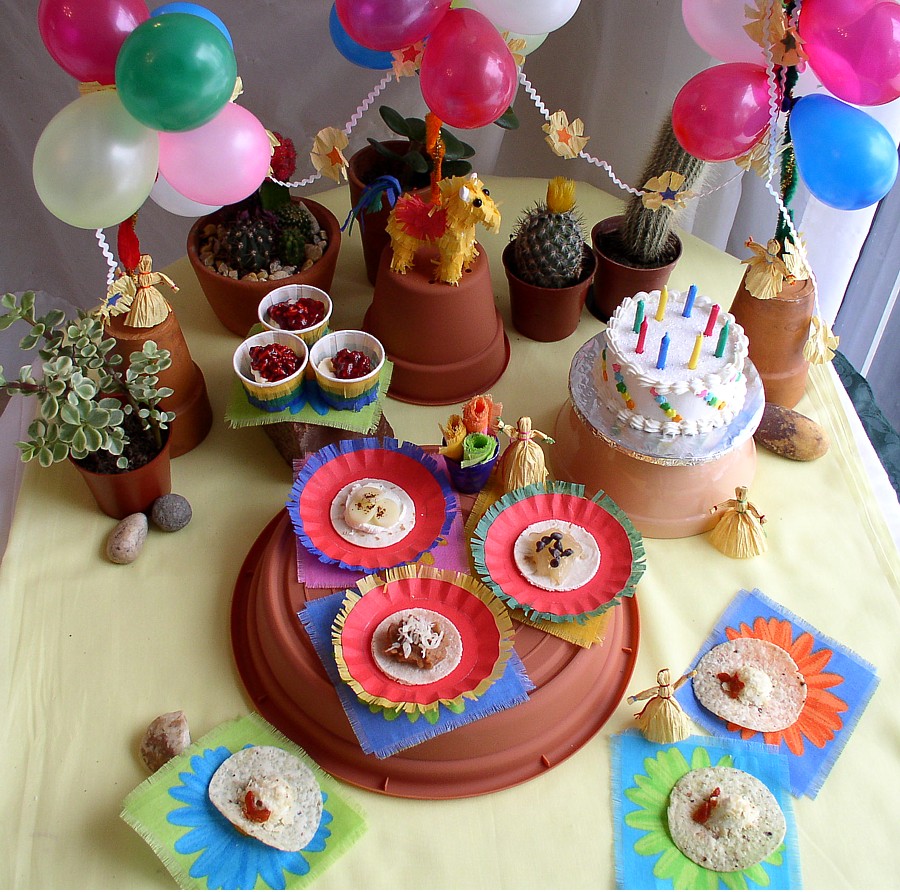
Host a doll-size Birthday Fiesta! This is one of the chapters that didn’t make the cut in Tiny Treats, a book I wrote in 2004. The centerpiece is a sweet little palm-sized pinata filled with real candy and plenty of delicious treats. Try the Three Teeny Quesadillas if you please or the Spicy Sombreros for a tiny treat. Use mini pinatas as place card holders or decorations on the table.

Miniature Birthday Fiesta!

For simple directions, see below.

For the Quesadillas, simply cut flour tortillas with a small round cookie cutter. Top with Beanie – refried beans and grated cheese, Cheesy – cream cheese with little slices of string cheese, sprinkled with paprika, or Sweetsie topping – apple pie filling with mini chocolate chips.

For the Spicy Sombreros, mix a little chili powder into cream cheese. Spread the cream cheese mixture in a little mound in the center of a round tortilla chip to make a hat. Sprinkle crushed corn chip crumbs over the cream cheese. Decorate with Pimientos.

Here are steps to make a Miniature Pinata.
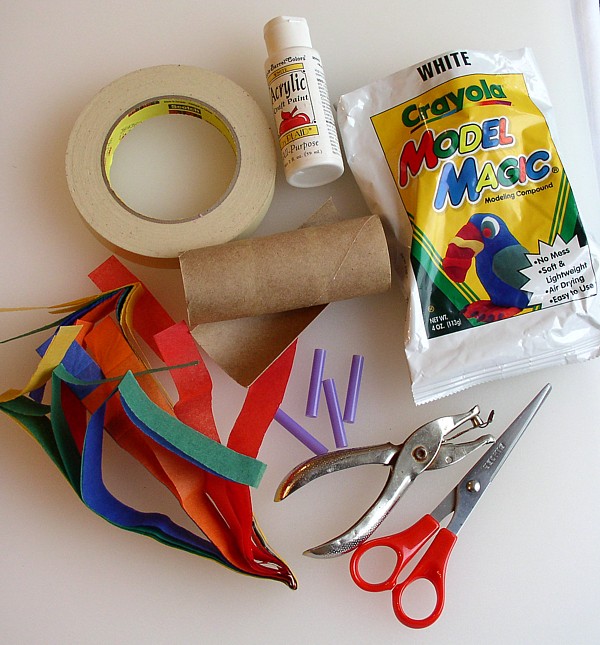
You will need:
Toilet paper tube
Scissors
Masking tape
Paper punch
4 pieces plastic drinking straw, cut 1 1/2” long
Mini candies
Crayola Model Magic modeling compound
White acrylic paint
Tacky glue
1/2” wide strips of colored tissue paper
2 small black beads

Supplies to make a miniature pinata

Step 1: Cut a toilet paper tube in half lengthwise. Cut a 2” section from one of those pieces. Roll it into a tube to make the body and tape it.

Prepare candy-filled tube. Add straw “legs”.

Punch 4 holes on one side of the tube for the legs. Insert the pieces of straw for legs. Before inserting the back legs, add small candies to the tube. Cover the ends of the tube with masking tape.
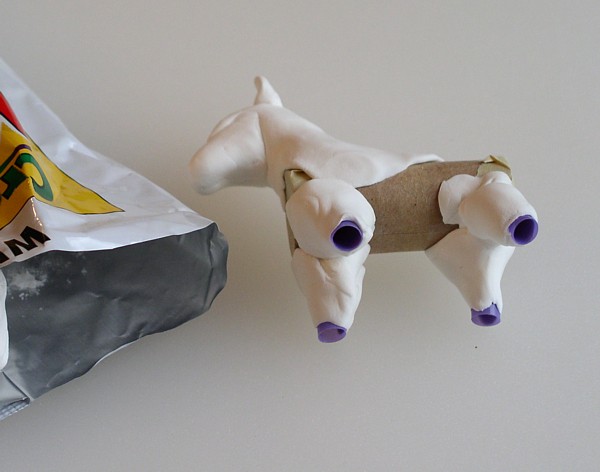
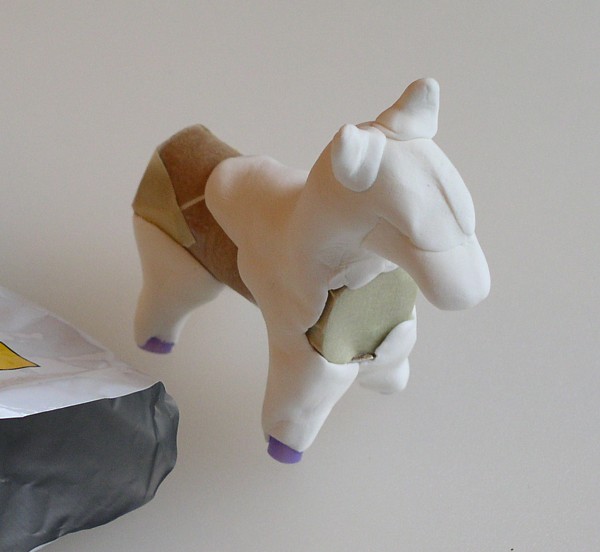
Step 2: Use Crayola Model Magic to form the neck and head of a donkey or horse. Add more Model Magic to make the legs thicker. Let dry overnight.

Add Crayola Model Magic clay to make a head and legs


Step 3: Paint the piñata white. Let dry.
Step 4: Cut fringe from the tissue paper strips. Spread the legs with glue and wrap them with the tissue fringe, starting from the bottom and working your way up. Glue on more pieces of tissue paper fringe and crumpled tissue paper as desired to cover the whole pinata. Glue on a tissue paper tale. Add two black beads for eyes.

Glue tissue fringe around pinata

To remove candy from pinata, pull tissue and tape off one end of the tube.
Ole!

Tiny Pinata

Share this:

  • Click to share on X (Opens in new window) X
  • Click to share on LinkedIn (Opens in new window) LinkedIn
  • Click to share on Facebook (Opens in new window) Facebook
  • Click to share on Pinterest (Opens in new window) Pinterest
  • Click to share on Reddit (Opens in new window) Reddit
  • Click to email a link to a friend (Opens in new window) Email
  • Click to print (Opens in new window) Print
  • Click to share on Tumblr (Opens in new window) Tumblr
Like Loading...
Newer posts →

If you are a non-WordPress follower, enter your email address to follow this blog and receive notifications of new posts by email.

Tags

All Sparkled Up allsparkledup altered book art baking beach beads bird bread breakfast cake candy carving cat cats chocolate Christmas Christmas tree cookies craft crafts dessert DIY Easter Easter eggs eggs egg tree encouragement fabric family figs flowers food funny gardening Gilded Girls God granddaughter grandkids heart home decor hope inspiration inspirational jewelry jewelry making joconde light Little Plastic Bears miniature miniatures mixed media mousse nature painting PB & J pets photo photography projects recipe roses salad Scoliosis scripture sewing snow sparkling Spoonflower sunlight sunset Sunset Beach surgery tablescape tea tree tutorial Valentine's Day vintage book words

Archived Posts

Top Posts & Pages

Craft Fail - Butterfly Wing
Marble window sills

Recent Posts

  • Today I remembered something that used to sparkle…
  • Sfogliatelle
  • Blue Willow Toile
  • The Kitchen tea towel
  • The little cake she decorated
  • Icing flowers
  • Matthew 11:28
  • Christmas at Sea Tablescape
  • Gratitude
  • The Hot Air Balloon mobile has lights
  • Journaling in Coloring Books
  • The Light is still here.
  • A Hot Air Balloon decoration for my granddaughter’s room
  • Coco’s new favorite hangout
  • My kitten is growing

Post Categories

All Sparkled Up allsparkledup altered books American Girl Dolls art baking Baking for Neighbors ballet beach beading BFN birthday books cake decorating calligraphy candy cats Christmas color community cooking Craft Fail crafts DIY dolls drawing Easter encouragement Etsy fabric family fashion design Favorite Childhood Books flowers food Free Idea funny gardening Gilded Girls Gilded Life God granddaughter grandkids handmade books holiday home home decor Inspirational jewelry making journals lighting Little Plastic Bears Mexican miniature mixed media music nature New Years On my Worktable painting party pets photography Princess doll projects recipe Scoliosis Scripture sewing sketchbook sparkling Spoonflower sunlight sunset tea time Thanksgiving The cats time tools travel tutorial Uncategorized Valentine's Day water wedding woodwork words wreath
Follow All Sparkled Up on WordPress.com

Create a free website or blog at WordPress.com.

Privacy & Cookies: This site uses cookies. By continuing to use this website, you agree to their use.
To find out more, including how to control cookies, see here: Cookie Policy
  • Subscribe Subscribed
    • All Sparkled Up
    • Join 287 other subscribers
    • Already have a WordPress.com account? Log in now.
    • All Sparkled Up
    • Subscribe Subscribed
    • Sign up
    • Log in
    • Report this content
    • View site in Reader
    • Manage subscriptions
    • Collapse this bar
 

Loading Comments...
 

    %d